New York • Paris • London • Palm Beach • Hudson Valley

Posts Tagged ‘Michelle-Marie Heinemann’


The market is undergoing continuous decline today after the overall market cap dropped $16 billion in 24 hours.

Bitcoin is down 8 percent and dropped from $6,700 earlier today now trading at under $6,200 with $6,000 being considered an important line of support

Meanwhile, Ethereum is down 10 percent and EOS is down over 15 percent. Litecoin has hit a 7 month low of $75, dropping 11 percent.

Market analysts and pundits have offered a variety of views on the subject, with the possibility that news from Japan has influenced the decline. Japan’s Financial Service Agency issued 6 exchanges with business improvement orders after conducting on-site inspections.

The national regulator is seen as cracking down on the exchanges by many after declaring that the exchanges needed to improve KYC regulations and work towards reducing risk. Major exchange bitFlyer responded by voluntarily announcing that they would no longer be accepting new customers pending review of their operational practices. bitFlyer will also be reviewing current identifications of existing users as part of the anti-money laundering measures.


Ryan Rabaglia, head trader of crypto-firm Octagon Strategy Limited, said:

“The market is still trading on low volumes and has yet to break out of its current downtrend, leaving itself susceptible to sell-offs. Although the market reacted negatively, I view this as a positive for the industry as a whole.”

On Monday, Blue Line Futures president Bill Baruch said that Bitcoin’s decreased volatility signaled that selling may finally be exhausted and may be bottoming out at around $6,000. He attributed the huge surge in value seen in December with the introduction of CME and CBOE Bitcoin futures allowing people to take long and short positions on the value of Bitcoin, with “tremendous speculation and the fear of missing out” seeing prices “sky-rocket too quickly.”

Baruch feels that the over-enthusiasm that caused unsustainable growth has now died down, which can now contribute to healthier and more natural market growth, saying that if the $6,000 support line holds we may see more constructive upward movement. He also pointed out, however, that the 100-day moving average was down to $4,550 at the time. Baruch outlined the $10,000 mark as a “crucial line in the sand”, and even advised selling against it.

It’s possible that the decline will continue in the short term as traders seek to preserve holdings, with eyes now on the $6,000 mark as a measurement of how far the decline will go before finding support and consolidating once again.


Written By: Conor Maloney

Image result for ccn

The cryptocurrency market has recorded a loss of over $17 billion in the past 24 hours, triggered by the loss of major cryptocurrencies including Bitcoin, Ethereum, Ripple, Bitcoin Cash, and EOS.

EOS recorded the largest loss amongst major digital assets, demonstrating a loss of more than 10 percent overnight. Ethereum, Bitcoin Cash, Litecoin, Stellar, and Cardano fell behind EOS, falling by just over 7 percent.

What Triggered the Sell-Off?

On previous reports, CCN noted that the cryptocurrency market is still in a bear cycle and that it had only initiated a corrective rally, not a bull rally. In mid-June, the market seemed more stable than any other period throughout the past two months. But, the unforeseen hacking attack of Bithumb, South Korea’s largest cryptocurrency exchange, terminated the corrective rally of the market and led major cryptocurrencies to a short-term decline.

Prior to the Bithumb hack, the cryptocurrency market had shown significant momentum, as Bitcoin rebounded from $6,300 to $6,700. But, the breach of the most widely utilized digital asset trading platform in South Korea, the third biggest cryptocurrency market behind the US and Japan, led investors to panic, even though the outcome was not particularly detrimental.

On June 21, CCN reported that Bithumb confirmed $30 million was stolen from its hot wallet and has started to cooperate with the Korea Internet and Security Agency, a sub organization of the Ministry of Science and ICT, to minimize its losses. The Bithumb team stated that the $30 million figure could decrease in the future, as KISA and Bithumb security experts initiate various recovery efforts.

“After the incident occured on June 20, Bithumb quickly followed the procedure to immediately report [the] incident to KISA announcing that about 35 billion Korean Won worth amount of cryptocurrency was stolen. However, as we undergo recovery process on each cryptocurrency, the overall scale of damage is getting reduced. Hence, we expect that the overall damage will be less than the amount we initially expected,” the Bithumb team said.

Bithumb also confirmed that with company funds, valued around $450 million, the exchange will be able compensate its investors fully with ease, as the stolen amount only accounted for around 6 percent of company funds.

Hence, the end result of the Bithumb security breach was not detrimental to the point of triggering a 6 percent cryptocurrency market correction. Rather, it was the end of an optimistic short-term corrective rally triggered by Bithumb that led the cryptocurrency market to experience a minor correction.

Where Ethereum Goes Next

Ethereum experienced the biggest loss amongst major cryptocurrencies today alongside EOS, and given that smaller cryptocurrencies and tokens follow the trend of BTC and ETH, the short-term trend of ETH is important to observe.

Various momentum indicators indicate neutral zone for ETH. The Relative Strength Index (RSI) of ETH is at 40.5 and the MACD of ETH is demonstrating a buy signal. But, a neutral signal for ETH, in a strong downward trend, could mean that its decline could be prolonged to the higher end of the $400 region, from the current price of ETH at $503.

Image result for cryptocurrency ethereum

Written By: Joseph Young

The excavation of the Aztec spiritual center, the Templo Mayor, by archaeologist Eduardo Matos Moctezuma provided otherwise unknowable information about the religion and society of the post-classical Mesoamerican empire.

The excavation of the Aztec spiritual center, the Templo Mayor, by archaeologist Eduardo Matos Moctezuma provided otherwise unknowable information about the religion and society of the post-classical Mesoamerican empire.

Prominent Mexican archaeologist Eduardo Matos Moctezuma on April 10 will deliver the first lecture on campus in the series that bears his name and honors his contributions to archaeology. The title is “Eduardo Matos Moctezuma Discovers Himself: Excavations of the Great Aztec Temple,” and the public talk will take place at 6 p.m. at the Geological Lecture Hall, 24 Oxford St.

Matos Moctezuma directed the excavation of the main Aztec site known as Templo Mayor in the late ’70s. His work unveiled major aspects of Aztec religion, life, and society to the world.

The five-year Eduardo Matos Moctezuma Lecture Series is a collaboration among the David Rockefeller Center for Latin American Studies, the Moses Mesoamerican Archive, and Harvard Divinity School.

Below is an interview with Matos Moctezuma, first published in the Gazette last year, in which he talked about the Aztecs and his breakthrough work. The interview is translated from the original Spanish.

Q&A

Eduardo Matos Moctezuma

GAZETTE: All ancient cultures have creation myths. What was the Aztecs’?

MATOS MOCTEZUMA: They believed they came from a place called Aztlan, hence the name Aztecs. Some experts think Aztlan is a myth because it has yet to be discovered. According to the myth, they left Aztlan guided by one of their gods until they arrived in the Texcoco Lake, in what’s now Mexico City, where they founded Tenochtitlan, the capital of the Aztec empire, in the year 1325.

GAZETTE: But how did the Aztec empire really originate? 

MATOS MOCTEZUMA: Mexico is a country with an ancient history that goes back 20,000 years. Before the Aztecs, there were the cultures of Teotihuacan, Monte Alban, Palenque, and Tajin. But the Aztecs, also called Mexicas, emerged in the 14th century when they freed themselves from their former masters, the Azcapotzalcos, after forming an alliance with the Texcocos and Tacubas. They began a large expansion across what is now Mexico and Mesoamerica through wars. It is said that when the Spaniards arrived in the early 16th century, the Aztecs ruled over 370 small city-states that paid tribute in goods to Tenochtitlan, the capital of the Aztec empire.

GAZETTE: The Aztec culture has been described as fierce and bloodthirsty. What were the Aztecs really like?

MATOS MOCTEZUMA: The Aztec was fundamentally a culture based on war and agriculture. Their two most important deities were Huitzilopochtli, the god of war, and Tlaloc, the god of rain. The duality of war and agriculture was crucial for the Aztec economy. The Aztecs expanded their empire through military conquest and sustained it through tributes imposed on the conquered regions. Every 80 days, the new subjects of the Aztecs had to pay tributes to Tenochtitlan. As for the Aztec society, it was very complex. It was socially divided between the nobility and the populace. The nobles included the ruler, the priests, and the military, all of whom had privileges and didn’t pay taxes. The poorer people had to work as painters, poets, sculptors, peasants, doctors, or architects. They attended schools to learn their trades and received military training to be prepared for wars. They also attended schools to learn about religion, music, and their language, the Nahuatl, which we know because they left codices with pictograms and texts that told their history. When the Spaniards came, Tenochtitlan had approximately 200,000 people. It was one of the world’s largest cities in the 16th century. The Aztecs were one of the world’s greatest civilizations.

GAZETTE: How do you compare the Aztecs to other great ancient civilizations, such as the Mayas, the Incas, the Chinese, or the Egyptians?

MATOS MOCTEZUMA:According to experts, there are six large regions in the world that are the cradles of civilization. Those regions are Egypt, Mesopotamia, China, the Indus Valley, Mesoamerica, and the Andes, where people developed civilizations independently, boasting large cities and strong states. In Mesoamerica, it was the Aztecs and the Mayas but also the Zapotecas, Mixtecas, Toltecas, etc., and in the Andes, the Incas, but also the Moche, Chimu, Chavin, and others. The Aztec was a strong state due to its military power, its religion, and its tribute system. They developed their own calendar of 18 months of 20 days each, built large cities and huge pyramids and temples, and developed a farming system called chinampas that they used to grow crops on shallow lake beds. They grew maize, beans, tomatoes, pumpkins, chilis, etc. The Aztecs’ contributions to the modern world are extensive, from agricultural products to farming techniques to stunning art and architecture.

GAZETTE: Let’s talk about the Aztec religion. Much has been said about the role of human sacrifice among Aztecs. What is the truth about human sacrifices?

MATOS MOCTEZUMA: The Aztec religion was primarily polytheist. They had different gods, male and female. The sun god was Tonatiuh. There were many deities, and they were revered in monthly festivities with rich offerings. There is this black legend that only the Aztecs used human sacrifices in their religious rituals, when there is evidence that they existed in many other ancient cultures that were mostly agricultural societies. In the Aztecs’ case, human sacrifices were meant to please the sun god so that he could continue providing them with light, warmth, and life. They believed that without human sacrifices, the sun could stop and everything was going to die. So the sun had to be fed so that it could continue with its movement, so that there would be day and night. But not all rituals demanded human sacrifices. In general, those who were sacrificed were slaves or prisoners of war.

GAZETTE: What factors contributed to the fall of the Aztec empire?

MATOS MOCTEZUMA: Before the arrival of the Spaniards, there were nine emperors, and during the war of conquest, two more. During the last 18 years of the Aztec empire, the ruler was Moctezuma II. In those years, the empire continued its expansion through war, but exacting tribute from their subjects created discontent among them. There were small rebellions, but the Aztecs, who had the military power, always won. When the Spaniards landed in 1519 in what is today Veracruz, the local people there, the Totonacas, complained to conquistador Hernan Cortes that they were subjugated by Moctezuma, the señor of Tenochtitlan. When Cortes heard this, he promised that they would be freed from paying tribute if they become their allies to overthrow Moctezuma. With their help, Cortes gained more allies among other disgruntled groups in the region, and he planned the advance towards Tenochtitlan. There is a myth about the question of how 800 Spaniards defeated a whole empire. Well, it wasn’t only 800 Spaniards. They were supported by thousands of indigenous people who wanted to get rid of Aztec rule. When the conquest happened, when Tenochtitlan was about to fall, surrounded by land and sea, those groups of local enemies of the Aztecs played a fundamental role in the fall of the Aztec empire. Also, the Aztecs used a tactic that worked against them. Unlike the Spaniards who came to kill, the Aztecs preferred to take prisoners of war for human sacrifices. The Aztecs captured Cortes, and they didn’t kill him because they were going to sacrifice him. But his comrades saved him. Moctezuma was taken prisoner and was killed by the Spaniards.

GAZETTE: Are you a descendant of Moctezuma, the Aztec emperor?

MATOS MOCTEZUMA: There are not too many who have that last name in Mexico. According to my mom, we are descendants of Moctezuma. But I am not sure, and I don’t care too much about it.

GAZETTE: You spent 40 years, a large part of your career as an archaeologist, excavating the remains of the Templo Mayor. What was the significance of the Templo Mayor for the Aztecs?

MATOS MOCTEZUMA: The Templo Mayor was the center of the ancient Aztec empire, the most sacred place for the Aztecs. In 2014, we celebrated the 100th anniversary of the discovery of the Templo Mayor. In 1914, Manuel Gamio found remains that led him to believe that the site was the Templo Mayor, which until then we had only heard about. But the site was in the middle of the city; it was actually underneath Mexico City. Years went by, and in 1978 electrical workers who were excavating underground found a big sculpture, which turned out to be a monolith depicting an Aztec goddess, which led to the discovery of the Templo Mayor. The same year, the Templo Mayor Project was founded, with me as the director, and under my helm and with a multidisciplinary team, we started excavations and were able to find a large part of the remains of the religious heart of the Aztecs. Excavations are still taking place, and, as in the past, we’re excavating the ritual heart of the Aztec empire, which we had only heard of before. After we dug up the remains of the temple, we were able to learn the role of the Templo Mayor in Aztecs’ life and the powerful symbolism it held in the empire. 

GAZETTE: What is left to learn about the Aztecs?

MATOS MOCTEZUMA: We’ve just scratched the surface of Tenochtitlan, the capital, but we still need to know how it was organized, the social hierarchies, and the way it functioned. Since it’s underneath the city, there is a lot still to be learned.


Written By: Liz Mineo

Harvard Staff Writer

Over the past several years, Harvard Art Museums has acquired hundreds of printer’s proofs of work by celebrated artists, photojournalists, and fashion photographers, in a boon for Harvard holdings of contemporary art. Some of that rich collection is now on display.

“Analog Culture: Printer’s Proofs from the Schneider/Erdman Photography Lab, 1981–2001” features approximately 90 black-and-white images from the Manhattan lab of Gary Schneider, an artist, photographer, and master printer, and John Erdman, an artist and expert retoucher.
On view through Aug. 12, the exhibit explores the dynamic exchange between artist and printer, the methods and materials used in printmaking, and the social forces that helped shape New York and the nation in the 1980s and ’90s. (The lab closed in 2001.)

“For me that range is what really makes the collection significant,” said the show’s curator, Jennifer Quick, Harvard’s John R. and Barbara Robinson Family Associate Research Curator in Photography. “It’s the granular, material history of photography, and the big broader social histories that it documents.”
 

David Wojnarowicz, Untitled (Buffalo), 1988–89.

“Untitled (Buffalo),” David Wojnarowicz, 1988–89, printed 1992.  © The Estate of David Wojnarowicz

One of the most haunting images on display is a photograph printed for the American artist and AIDS activist David Wojnarowicz, who died from the disease in 1992 at the age of 37. For many, Wojnarowicz’s shot of buffalo plunging off a cliff — a picture of a diorama he snapped at the National Museum of Natural History in Washington — reflected not just the horror of the AIDS crisis but also the nation’s early apathy toward victims of the disease. The band U2 used the picture as cover art for the single “One,” donating sales to AIDS research.

In an interview, Schneider, a filmmaker and photographer by training, said that the choice of a “very bright” French paper called Brilliant helped render Wojnarowicz’s image “holographic.”

Becoming a printer was a natural progression for Schneider, who took a job in a photo lab to help him get through grad school at the Pratt Institute in the late 1970s and soon fell in love with darkroom work. Later, at the urging of a friend, he and Erdman, his partner, began printing works for other artists in their apartment in St. Mark’s Place. The spare bedroom doubled as a darkroom; the living room quickly filled with racks of drying prints. Eventually they moved to a studio in Cooper Square.

Gary Schneider and John Erdman at Harvard Art Museums exhibit.

Gary Schneider (left) and John Erdman with some of their iconic prints on view at Harvard Art Museums through Aug. 12.  Rose Lincoln/Harvard Staff Photographer


Erdman managed the books, but as the business grew, he also developed into a skilled retoucher. The shop became a regular stop for a who’s who of the East Village art scene. Famed portrait photographer Richard Avedon enlisted Schneider and Erdman to print a set of Beatles images. Madonna sought their expertise for her “Sex” coffee table book, a project that involved nondisclosure agreements and a range of creative voices. Nan Goldin, Peter Hujar, Lisette Model, and James Casebere, among many other noted artists, were regulars.


Peter Hujar, John Erdman and Gary Schneider at Mohonk Mountain House, 1984.

Peter Hujar, John Erdman, and Gary Schneider at Mohonk Mountain House, 1984, printed 2013.  © Peter Hujar Archive


Through the years, Schneider’s own gift with the camera helped inform how he translated an artist’s negative to a finished print. He likened his work to a kind of performance in which he channeled the ideas of others, using his experience and creative eye to develop options for clients whom he insisted arrive prepared.

“If they didn’t have a vision for the work I wasn’t going to create one for them,” he said. “I couldn’t.”

What he could do was deliver “a number of choices or alternatives,” by selecting the right combinations of paper, ink, toner, and developer, and by deciding how long to expose a work to enhance shadows or highlights.

“Even when I am dealing with a student, it’s their voice that I am looking to reveal to them,” said Schneider. “With an artist, it’s their desire that I’m searching for.”

The printing process is about “how far can I actually catalyze that artist’s voice or that artist’s desire rather than my own,” he said.


Lisette Model, Fashion Show, Hotel Pierre, 1940–46, printed 1982.
Nan Goldin, Naomi in the audience, Boston, 1973, printed 1990–91.

“Fashion Show, Hotel Pierre,” Lisette Model, 1940–46, printed 1982; “Naomi in the audience, Boston,” Nan Goldin, 1973, printed 1990–91.  © The Lisette Model Estate/Bruce Silverstein Gallery; © Nan Goldin

Peter Hujar, Will, 1985, printed 1987.

“Will,” Peter Hujar, 1985, printed 1987. © Peter Hujar Archive

Archival material, books, and an Irene Bayer photo from Schneider and Erdman’s personal collection are part of the exhibit, along with key darkroom items such as test prints, a light valve technology negative, and “masks” — material used to cover an area of a print to limit its exposure time. All help shine a light on Schneider and Erdman’s process.

Ensuring the collection would be housed at an institution devoted to teaching and learning was key for the pair, who led various demonstrations and discussions with Harvard students in the months before the exhibition.

“We always viewed the collection as a study collection,” said Erdman, who accompanied Schneider to Harvard in 2004 for the installation of “Gary Schneider: Portraits.”

It was during that visit that they were struck by the Fogg Art Museum’s Agnes Mongan Center for the Study of Prints, Drawings, and Photographs, and its commitment to teaching. “We fantasized about [our collection] coming here,” said Erdman.


Written By: Colleen Walsh

As the Earth continues to heat up, so have calls to dramatically reduce carbon dioxide emissions to avoid catastrophic climate change. But many experts say that even if all emissions stopped tomorrow, the planet would continue to warm and seas would continue to rise.

A key issue is that atmosphere would still be clogged with 200 years’ worth of human-produced carbon dioxide. “The question is, what do we do with all this excess CO2 in the atmosphere?” said Noah Deich, executive director and co-founder of the nonprofit Center for Carbon Removal.

A new application of old technology may be the answer. “Direct air capture” that removes the gas from ambient air has possible since the 1940s, but — at a cost estimated in 2011 to be as much as $1,000 per metric ton of CO2 — it has long been viewed as too expensive to be practical.

David Keith, the Gordon McKay Professor of Applied Physics at the Harvard John A. Paulson School of Engineering and Applied Sciences (SEAS) and professor of public policy at the Harvard Kennedy School, thinks it can be done for a lot less. He and his colleagues estimate that their company, Carbon Engineering, could capture CO2 for between $94 and $232 per metric ton. In the journal Joule, the team outlined the material and engineering costs of their system — the first time the costs of a commercial direct-air-capture process have been published. The paper could have major ramifications across the industry.


Image result for c02 emissions

“Until now, basically no one in the industry has published an open-book number that will give credibility that direct air capture costs less than the $500 to $1,000 per metric ton that has been estimated,” Deich said.

CO2 molecules make up only .04 percent of the air — that’s one in 2,500 molecules. Nonetheless, “We need enormous volumes of CO2 removal and to achieve that, we need accurate economic analysis and hard engineering data,” said Julio Friedmann, CEO of Carbon Wrangler LLC and senior advisor at The Global Carbon Capture and Storage Institute. “This paper provides that transparency.”

Keith co-founded Carbon Engineering in 2009, when direct air capture was still on the fringes of industrial climate solutions. Carbon Engineering’s goal is to use direct air capture to produce carbon-neutral fuels and converting carbon-free energy into high-energy fuels for vehicles such as planes and barges, which are difficult to electrify.

The Carbon Engineering team’s approach differs from their few competitors in the field.

“We’re not developing a fundamentally new product or unit operation,” said Keith. “That’s the design choice we made. We’re making something that’s never been done before — commercial large-scale air capture — but we’re doing it on a basis of technology that already exists.”


Artist’s rendering of Carbon Engineering’s air capture design. This unit would be one of several that would collectively capture 1 million metric tonnes of CO2 per year.

In the Carbon Engineering system, a remodeled industrial cooling tower containing a liquid hydroxide solution captures CO₂ and converts it into carbonate. The carbonate is then converted into pellets in equipment originally created to extract minerals in water-treatment plants. Finally, the carbon pellets are heated in a kiln originally designed for roasting gold, and transformed into pure carbon dioxide gas, which can be turned into synthetic fuel.

Keith’s team worked directly with commercial suppliers of each of piece of repurposed equipment to design tests, engineer alterations, and develop cost estimates to adapt the hardware for a commercial direct-air-capture plant.

“In a post-Paris Accords world, everyone has been talking about carbon removal but most of the analysis is secondary literature or policy perspectives,” said Keith. “This is the first paper to estimate the cost of direct air capture based on a detailed engineering design and cost analysis. While uncertainties, of course, remain, the fact that it can be built using established processes and suppliers gives us confidence to develop industrial-scale plants.”

With that cost breakdown, direct air capture — especially direct air capture that can be used to make synthetic fuel — may look less exotic and more attractive to investors and policymakers.

In addition, the technology is location-independent, which should add to its allure, said Joe Lassiter, retired Senior Fellow and Senator John Heinz Professor of Management Practice in Environmental Management at the Harvard Business School.

“A commercial carbon capture facility could be located anywhere in the world where renewable or nuclear is inexpensive,” said Lassiter. “This is an example of how engineering and human cleverness can find economically feasible and sustainable solutions to the problems that society faces.”

To date, Keith and the Carbon Engineering team have raised about $30 million. The next step is to raise funds for a plant that can deliver fuels to market, which depends on finding a renewable power supplier who wants to supply high-capacity power at a low price and incentives for low-carbon fuels.

“I hope this paper will launch 1,000 master’s students to figure out how to create an even better future using this technology,” said Friedmann.

Image result for co2 removal technology


Written By: Leah Burrows

When a new designer somehow manages to change the aesthetic scene of an entire event, it’s a pretty safe bet they’re the next big thing. Such was the case with this year’s Whitney Art Party, with Alexandra O’Neill giving the crowd a much needed ‘Kira Kira’ shine, dressing everyone from Hilary Rhoda to Ashley Graham in her line Markarian’s latest collection of dream, prêt-à-party dresses.Fresh off a November launch on The Platform, Moda Operandi’s new incubator for emerging designers, Markarian’s is a “feminine and ethereal” look – one pretty piece after another that will have you making an occasion out of just about anything. As one who clearly practices what she preaches, Alexandra’s Greenwich Village home is just as well styled as the designer herself. We caught up with Ali at her divinely decorated downtown abode to get the skinny on everything from her must-shop stores to that one piece every woman should have in her closet. 


How did you find yourself in the design world?

My grandmother, GiGi, lived with my family growing up and taught me how to sew at a very young age. I fell in love with making clothing when I was 10 and always knew this is what I wanted to do. GiGi still helps me with tricky patterns and structure now.


What’s your favorite occasion to dress for?

I will take any excuse to dress up a little and love getting dressed for the holidays. My grandparents throw a party at their home on Christmas Eve every year that our whole family gets decked out for. My Great Aunt Beth has worn this incredible gold velvet floor length skirt for the past 30 years that is beautiful. The party is so festive and puts you into such wonderful holiday spirits.


What’s your everyday go-to look?

Light washed Levi’s, a t-shirt, and a vintage jacket.


What are some of your most loved labels or stores?

I am a vintage hound. My favorite vintage store in the city is Edith Machinist in the LES. I also find such incredible treasures at the Manhattan Vintage show every time it happens. Other stores I love are Antony Todd home, the Apartment by the Line, and the well curated collections and events at the Moda Operandi Madison store.


What’s the one piece every woman should have in her closet?

A knock out dress that she always feels beautiful in no matter where she’s going or what she is doing.


Would your ideal night be going out or staying in?

I love having people over to my apartment for dinner parties or movie night, everyone feels at home there. I do also love to go out dancing every now and then though…


What was your favorite part of designing your apartment?

I loved scrolling through all of the listings on 1st dibs.


Who’s style do you just adore?

GiGi’s!


Written By: Christie Grimm

Something truly amazing is FINALLY coming to the Hamptons!!! A true one hundred percent vegan café!


And while there are certainly plenty of suitable options for the health-conscious out East, the Hamptons is finally getting a 100%, totally vegan café. The Plant Based Coffee Shop, set to open this June, is the brainchild of Marley and Lennon Ficalora, two vegetarian-raised brothers who set out to create an establishment which would “make healthy plant-based food affordable and accessible to everyone.”


So, for those who want to maintain their Gwyneth-approved lifestyle (or just try it out), this café is the best thing to hit the East End since the SoulCycle BARN.


Plant Based Coffee Shop, 2487 Main Street, Bridgehampton

The Plant Based Coffee shop will feature cafe staples such as wraps and bowls, along with cold brew and kombucha on tap. It will be open daily from 10 am to 4 pm. Stay tuned!

Written By: Danielle Spoleti

Summer has finally sprung upon us. Though you may prefer to escape the hustle and bustle in favor of the crisp air near the Aegean Sea, spending summer in the city is truly magical, especially since you can, literally, find a taste of Mediterranean serenity without having to island hop. If you can’t afford an exotic adventure to Greece or Coastal Italy, you can, at least, take your taste buds on vacation.

Cafe Medi

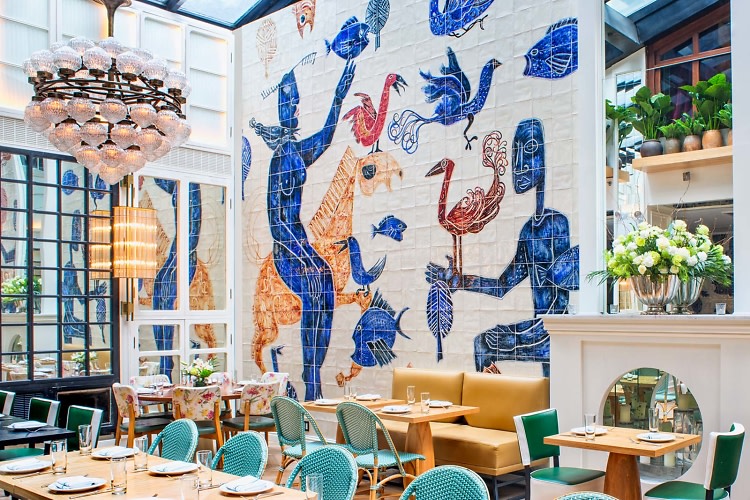
 Serving up dishes inspired by the traditional coastal fare of Spain, Italy, and France, Cafe Medi is not only a go-to for delicious and unique Mediterranean, but also for an amazing ‘gram. The beautiful space boasts an airy atmosphere, complete with high ceilings and stunning murals on the walls. Come summer, there’s also outdoor terrace seating – perfect for pretending you’re catching a seaside breeze.

Cafe Medi, 107 Rivington St.


Yefsi Estiatorio

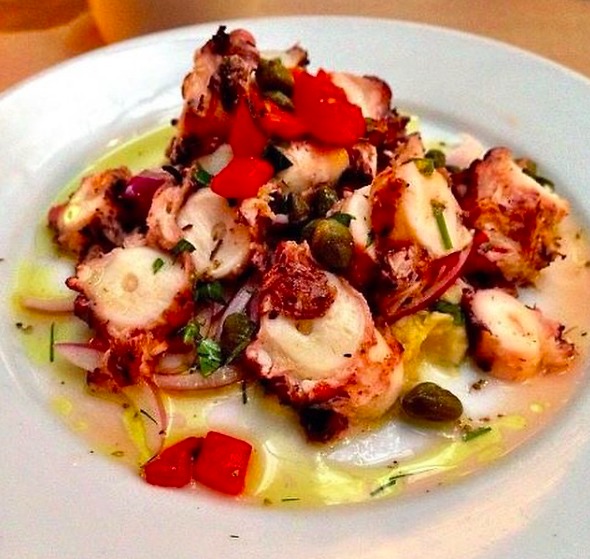
Located on the Upper East Side, Yefsi highlights charm and sophistication in their authentic meals, focusing on appetizer meze dishes. Enjoy a plate of grilled octopus with a chilled Retsina white wine in this dimly lit restaurant. Date night, anyone?


Yefsi Estiatorio, 1481 York Ave.


Avra

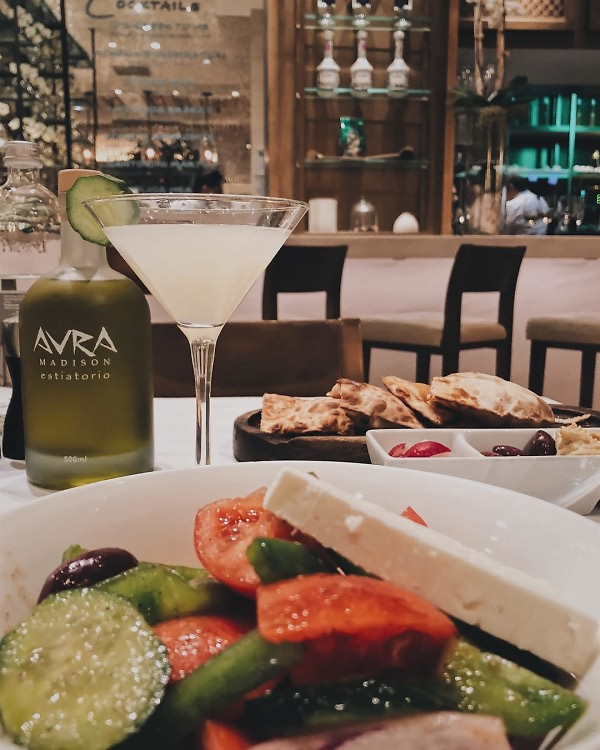
Craving seafood? This upscale eatery on Madison Avenue emanates a “villa vibe” with extended outdoor seating available, displaying fresh whole fish from the Aegean upon entrance.


Avra Madison Estiatorio, 14 E 60th St.

The Greek

The Greek Tribeca offers a cozy escape, where creative dishes and natural vines and greenery capture the spotlight, as if you were sitting in an outdoor taverna in Mykonos on a hot summer night.


The Greek,  458 Greenwich St. 

Estiatorio Milos

Named after the volcanic island featuring pristine clear-blue water, Milos is an NYC favorite. Its sleek interior truly brings out the contrasting colors native to Greece and sharpens the focus on the incredible seafood.


Estiatorio Milos, 125 W 55th St.

Ousia

Just a quick drive down the West Side Highway transports you to the beauty of Greece as you stumble upon Ousia, a recently opened restaurant on 57th and 11th. Conveniently located next to the Landmark movie theater, enjoy a bite of their hummus and pita, maybe some cocktails and a spanakopita, after a show.


Ousia, 629 W 57th St.

Souvlaki GR

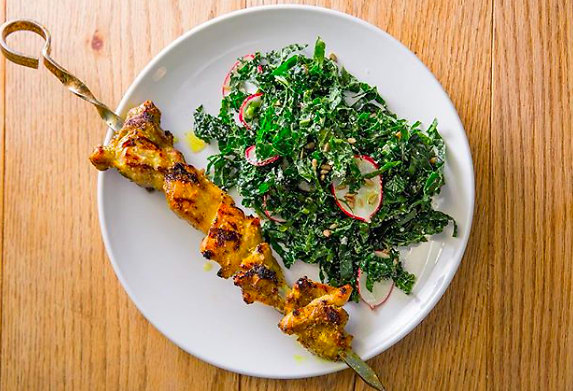
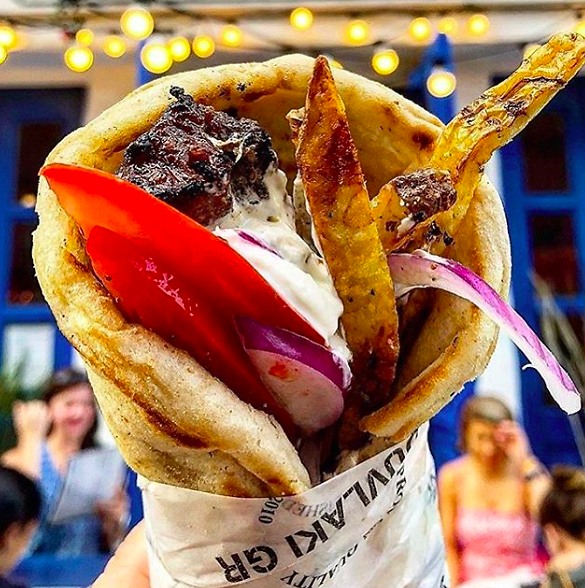
Walking down the grey and white cobblestones, you will immediately feel as if you’ve stepped foot into a local taverna in Santorini, greeted with white walls and blue straw chairs. If you’re looking for something more laid-back but as equally delicious as an upscale restaurant, journey to Souvlaki GR for their famous bifteki sandwich or a few souvlaki skewers. Sit back, relax, and breathe in the fresh air of Greece while situated in the middle of the Lower East Side.

Souvlaki GR, 116 Stanton St.

Santina

Tired of Greek food? Hop on over to the Amalfi coast for this Italian-Mediterranean fusion restaurant situated just beneath The High Line. The glassed-in, jewel box of a space creates the perfect atmosphere to munch on some seafood and pasta after a day of roaming around Chelsea.


Santina, 820 Washington St.

Shuka

A small, intimate setting with colorful plates for curious palates awaits New Yorkers on Macdougal street. Shuka offers Mediterranean fare, creative cocktails, and a trendy clientele. Enjoy shawarma, shakshuka, and other small plates as you wine and dine while seeing and being seen.


Shuka, 38 Macdougal St.


Written By: Stella Stephanopoulos

Whether you’re looking for adventure on the steppes or a hammock steps from the ocean, here are the best trips to take this summer.

June 21 marks the first day of summer in the Northern Hemisphere, and vacation season is in full swing—with plenty of destinations to choose from, no matter your style or speed. To make decision time go as smooth as that beach side sangria, take a look at our list of 2018’s best summer trips.

BORNEO

If you love pygmy elephants, glow-in-the-dark mushrooms, floating markets, secret gardens hidden in caves, and the rehabilitation of endangered orangutans—then Borneo is the summer trip for you. After a day of spelunking in Borneo’s Gunung Mulu National Park, visitors can stick around to observe the “Bat Exodus,” as over three million bats swoop into the fading sky from Deer Cave, the largest cave chamber on the planet. Borneo is also the place to spot Irrawaddy dolphins, proboscis monkeys, soft-shelled turtles, clouded leopards, the world’s longest insect, and 15,000 species of plants—including carnivorous pitcher plants; the famous corpse flower; and monster flowers, the largest known blossoms on the planet.


Cloud forest covers the mountains in Malaysia, on Borneo. Several countries—Malaysia, Indonesia, and Brunei—make up the island’s territory.


ICELAND

Iceland is so much more than a quirky layover or winter Northern Lightssite. From May through June the midnight sun provides plenty of daylight hours for soaking in thermal pools, hiking on glaciers in Skaftafell National Park, and sidestepping tide-washed icebergs on black-sand Diamond Beach. In Iceland, mosquitoes don’t exist; the temperature hasn’t gone above 87°F since 1939; and the tap water, filtered underground through ancient lava fields, is some of the purest drinking water in the world. Spend the afternoon beside bubbling mudpots, the black basalt falls of Svartifoss,the magic mossy cascades of Skógafoss … and you’ll see exactly why most Icelanders still believe in elves.


Skógafoss is one of Iceland’s most iconic waterfalls.


    ILHA GRANDE

Brazil’s Ilha Grande may only be a 15-minute boat ride from Jacareí (or a roughly hour-long ferry from Rio), but its 106 quiet beaches, musical rainforests, and car-free streets feel a world away. Most of the island is protected within Ilha Grande State Park, meaning the jungle hikes to Parnaioca and Lopes Mendes Beach offer sightings of many endangered tropical species, including maned sloths, brown howler monkeys, and the red-browed amazon parrot. Stay in a breezy pousada, drink passionfruit caipirinhas lagoon-side, or visit one of the island’s over 30 restaurants for a bowl of traditional shrimp moqueca—a bright stew of fresh seafood steeped in coconut milk and palm oil.


Clouds skirt Mount Bromo, an active volcano in Java, Indonesia.


LEBANON

The Spaniards argue that crème brûlée is just a French version of crema catalana. Welsh historians claim Arthur Guinness smuggled his famous stout recipe from a Welsh tavern to Dublin. And Lebanon … Lebanon wants their hummus back. Often overlooked as a culinary destination, Lebanon crafts the ideal summer mezze table in an equally ideal temperate climate. Stroll open air markets in Byblos, one of the world’s oldest cities. Cool off at the Baatara Gorge Waterfall. Then settle in beneath the cedars for a feast of local wine, tabbouleh, tiny rounds of hot sesame pita, baba ghanoush sprinkled with pomegranate seeds, and plates of herb-y cheese, all drizzled in bright swoops of local olive oil.


Lebanon is an overlooked culinary destination.


MASAI MARA

There are few African safari lands that get as up-close-and-personal as Masai Mara, an expansive and fenceless preserved savannah that stretches between Kenya and Tanzania. The region is home to a dream team of wildlife including lions, cheetahs, zebras, elephants, giraffes, gazelles, rhinos, leopards, and baboons. July through September is the best time to visit, when two million wildebeest bravely storm across crocodile-clogged rivers and grassy plains on their annual migration to the Serengeti. Witness the tension by safari car or on horseback, sail over hippos in a hot air balloon, visit a local Maasai community, then snorkel off that savannah sand in the coral reefs off of Kenya’s peaceful Diani Beach.

Image result for masai mara


Late summer to early fall is the best time to see Masai Mara’s famous wildebeest migration.


MONGOLIA

Medical anthropologist and National Geographic explorer, Carroll Dunham, and her family have spent sixteen blue-sky summers living among nomadic tribes in Mongolia—one of the least population-dense, and most hospitable, countries in the world. And while Dunham loves camping in a traditional ger, watching archery displays at local Naadam festivals, and horseback riding through wild poppies—she says the main reason her family returns is for the people. “No one can sing from the depths of their being and bellies like the Mongols,” she writes. Landlocked Mongolia is known for its 1,000-foot-high singing dunes, crystal clear rivers, cool summer nights, ancient dinosaur fossils, bad cell service, exquisite cashmere, Buddhist lamas, and golden mountains. One spirited horseback ride through these green steppes and we’re sure you’ll be throat singing too.


Wild horses graze on a Mongolian plateau. National Geographic offers an expedition that allows visitors to explore the country on horseback with local experts.


PAPUA NEW GUINEA

May marks the end of the rainy season in Papua New Guinea, making summer the best, and least slippery, season for hiking the Kokoda Track—a historic 60-mile mountain trek along waterfalls, rope bridges, and vibrant villages. Further north, in Mount Hagen, more than 70 tribal groups gather every August for the Sing-Sing Festival, a joyful celebration of ancestral song and dance with lizard-skin drums, swishing grass skirts, conch-shell necklaces and stunning feather headdresses. A dream destination for snorkeling, diving, and birding, PNG claims over 600 islands, 800 native languages, and almost all 43 unbelievably colorful species of birds-of-paradise, including the stunning, neon-blue-feathered Vogelkop, just identified this year by ornithologist Edwin Scholes and National Geographic photographer Tim Laman.


Papua New Guinea is famous for its biodiversity, both on land and at sea.


PERU

Peru enjoys its dry season from May through October, meaning clear skies and sun are likely for Inti Raymi, one of the biggest festivals in South America. Every year, the climax of the festival falls on June 24: Hundreds of dancers in handwoven ponchos descend on Cusco to sing, burn fires, and call upon the Sun God in a stunning day-long ritual that has been performed since the early Incan empire. If crowds in the thousands-plus unnerve you, an August trip to similar, smaller festivals in Wiracochapamp and Huamachuco promise firework displays, fewer tourists, and equally colorful turco and campesino performances.


Peru’s traditional Inti Raymi festival climaxes on June 24.


YOSEMITE

This year California’s Yosemite National Park will complete a four-year-long ecological restoration of the Mariposa Grove. On June 15, the magnificent stand of over 500 giant sequoias will reopen with restored hydrology, accessible shuttles and trails, and better-protected habitats for both the trees and their resident weasel-like Pacific fishers. Yosemite’s towering Sequoiadendron giganteumcan survive for thousands of years—thanks in part to their virtually fireproof bark and naturally insect-resistant tannins. The largest trees by volume on Earth, some sequoias measure up to 154 feet in diameter. After a day of tree-gawking, opt for a May Lake picnic at the base of Mount Hoffmann, or take a hike along Yosemite’s 11.5-mile Valley Loop Trail for gigantic views of El Capitan, Yosemite Falls, Bridal Veil Falls, and Cathedral Rocks. Yosemite is the perfect summer place to get outside and feel oh-so-gloriously small in the most delightful way.

Iconic views—like this vista of Bridal Veil Falls—make Yosemite one of America’s most beloved national parks.


Written By:Caitlin Etherton

Related image

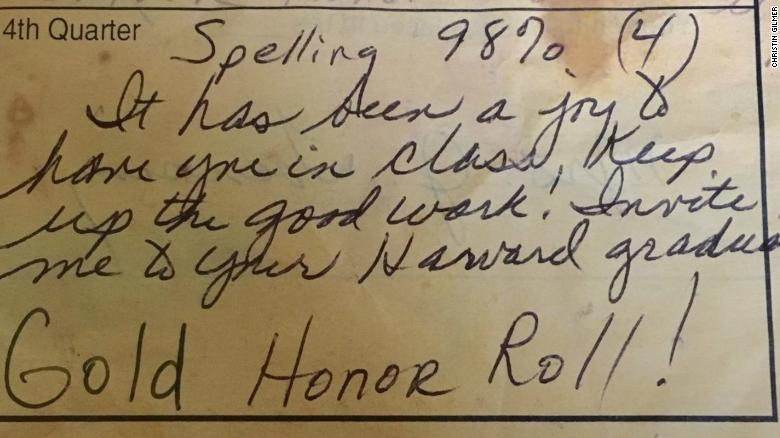
Judith Toensing didn’t just teach her students, she inspired them. A sixth-grade teacher from Yuma, Arizona, Toensing made a strong impact on one of her students 21 years ago. At the end of the school year in 1997, Mrs. Toensing, wrote a note on the student’s report card: “It has been a joy to have you in class. Keep up the good work! Invite me to your Harvard graduation!.” This week, the student, Christin Gilmer graduated from Harvard as a doctor of public health.

Mrs. Toensing wrote a note on this 12-year-old's report card back in 1997.

Mrs. Toensing wrote a note on this 12-year-old’s report card back in 1997.
 Gilmer who is now 33, was only 12 at the time, but she kept the message all these years.
“It meant a lot to me to know that outside my mom, someone who knew me so intimately believed in my dreams and my ability to accomplish them,” Gilmer told CNN. Gilmer, who wrote a thank you note prior to her graduation, said Toensing was the first person to encourage her in the journey of studying public health.
“Ms. Judy Toensing, taught me about current events, global health, and human rights. She was the first person who passionately conveyed the plight of people living with HIV/AIDS to me,” the letter said.
This letter quickly grabbed the attention of school administrators, who decided to honor Toensing by inviting her to the 2018 Harvard T.H. Chan School of Public Health’s convocation, at no cost to her.

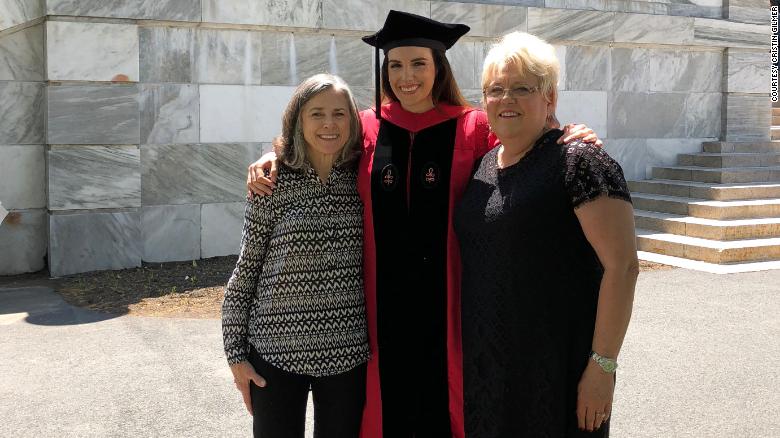
Mrs. Toensing and Gilmer's mom posed for a photo after the ceremony.

Mrs. Toensing and Gilmer’s mom posed for a photo after the ceremony.
Dean Michelle Williams thanked Toensing — and all public school teachers — for the “immeasurably important” work they do.
“You don’t just teach young people. You inspire them, and you propel them along a path of fulfillment and service to others. Your work is what makes our work possible,” Dean Williams said.
This came to a surprise to Toensing, who felt “shocked, flabbergasted, humbled” when she received the invitation from Harvard, which was personally delivered to her by Gilmer.
“I have high expectations of all my students, so to hear that Christin had achieved this goal did not surprise me in the least,” Toensing told CNN. “I feel honored that Harvard chose to tell Christin’s story, her journey, and that I was a small part of that journey,” she added.

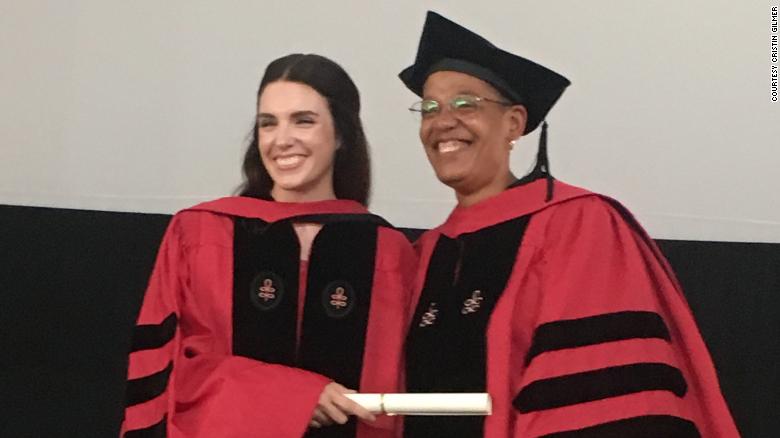
Christin Gilmer received her doctor of public health degree on May 23, 2018.

Christin Gilmer received her doctor of public health degree on May 23, 2018.
Gilmer who got her master’s degree in public health at Columbia University, says that Toensing always encouraged her students to think of ways to help others.
“She lit a fire in me that helping people is a powerful tool, and through education, you can better serve populations in need. I will never forget her passion for others,” Gilmer told CNN. As a student in Toensing’s class, she and others wrote a 100-page advertisement, interviewed the mayor and envisioned how recycling could work in their town 15 years before it actually happened, and helping others is something she plans to focus on.
“I would love return to southern Arizona to work in health, politics, and community development,” Gilmer said. “I wanted to learn from the best institutions in the world so that I could bring back the knowledge and skills I have obtained and share them with the communities from which I came.” Toensing, who says this experience revitalized and energized her to become a better teacher for her students, praised all the hard work Gilmer has done and believes this is just the beginning of a great future.
“She has many more miles to go, I know with her tenacity, her dedication, and her passion for helping humanity, she will be highly successful and that we will all be the better for knowing her,” Toensing said.
Toensing, who taught Gilmer all her sixth-grade subjects, now teaches sixth- and eighth-grade Social Studies.
Written By: Andrea Diaz, CNN
CNN’s Carma Hassen contributed to this report