New York Paris London Palm Beach Hudson Valley

Posts Tagged ‘Old Fashioned Mom Magazine’

Katie Holmes
Photo: Getty Images

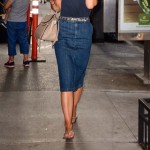
Katie Holmes played Jackie Kennedy in the 2011 mini-series The Kennedys, and yesterday in New York City—for the second time in recent memory—the actress’s street style appeared to be taking cues from the first lady. Holmes stepped out in a simple tee, below-the-knee pencil skirt, and spare sandals paired with oversize shades and a classic lady bag, offering up an elegant approach to casual daytime dressing.

Polished denim is having a moment—last week, the Duchess of Sussex wore an A-line denim dress by Carolina Herrera—and Holmes’s navy-on-indigo palette had an elongating effect. A snakeskin belt, Céline belt bag, and neutral-hued flip-flops rounded out the ensemble with polish and ease.

But the most winning accessory of all was Holmes’s oversize shades—no doubt Jackie O would approve.


Written By: 

SZA in a floral dress and a pair of Balenciagas at the 2018 Panorama music festival in NYC.
Photo: Courtesy of SZA / @sza

New York City’s Panorama Music Festival got off to a bit of a rough start—the second half of performances on the first day were cancelled due to thunderstorms, and eager festivalgoers had to evacuate Randall’s Island in the pouring rain. The inclement weather didn’t seem to dampen the spirits for the rest of the weekend, thankfully, and artists appropriately came out in their festival-style best: Michelle Zauner of Japanese Breakfast managed to keep things sparkly in a semi-sheer, sequined ensemble for her performance on Saturday, and David Byrnekept things classic in a sharp gray suit on Sunday.

SZA’s Panorama outfit was equally noteworthy: The Ctrl singer-songwriter donned a deceptively demure deep gray dress with light pink floral accents to her set on Saturday. From the front, the prairie-style frock appeared quite prim with its flowing long sleeves and high neck cut, but based on the Instagram video that showed her walking out onto the stage, this seemingly sweet piece also had quite the revealing back cut-out. In true tomboy fashion, SZA paired the summery dress with a chunky pair of Balenciaga sneakers—even when she’s trying out a girlish look, she still manages to bring an androgynous edge to the ensemble.

Whether consciously or not, SZA’s Panorama outfit makes the case that perhaps the best antidote to the ugly-sneaker trend is a proper prairie dress—or, since opposites attract, vice versa. So next time you don a Batsheva gown, consider offsetting the old-school silhouette with a pair of platform Buffalos—SZA would approve.


Written By: 

Have you been drowning the summer away in Aperol Sprtizes while wearing an  with Susan Alexandra cherry earrings and cherry-adorned Mary Janes from Clara Cornet’s Carel collaboration? I have. And in consciously consuming every produce print I can get my hands on, including a vintage Sônia Bogner dress I copped on TheRealReal, and lusting after a few more (see this ’70s maxi dress from Morphew), I’ve realized that no pattern will come to define the summer of 2018 quite like a fruit one.

They’re everywhere, inescapable, like the sticky humidity in the subway or the selfies from a Revolve-sponsored weekend in Bermuda. Once you open Instagram, you’re guaranteed to see something fruit-printed. There’s a cute Ganni clutch. Scroll further and you’ll come upon Prada’s remake of its Spring 2011 bananas. Later, a beaded pair of  that look like something Carmen Miranda would have worn.

Dior's berry toque, at left, in a 1953 edition of Vogue alongside a tomato-embroidered dress by Givenchy

Dior’s berry toque, at left, in a 1953 edition of Vogue alongside a tomato-embroidered dress by Givenchy

Illustration by Carl Oscar August Erickson, Vogue, May 1, 1953

It’s not unprecedented in fashion. Go back to the 18th century, and you’ll find records of the aristocracy wearing waistcoats embroidered with berries. (Speaking of which, is that a berry or a bloom on Louis Vuitton’s Spring 2018 version?) In a more modern era, Elsa Schiaparelli, fashion’s great subverter and Surrealist, delivered a toque hat of bacchanal grapes in 1939. Dior had a sweeter take on his tart topper of 1953, with cherries, blueberries, and strawberries coming to a widow’s peak between the wearer’s eyebrows. In those two hats, you have the two conflicting sides of this delicious trend: With Schiap, it’s carnal, consumable. With Dior and his femmes-fleurs, it’s naive, tender, all-natural, almost girlish. This makes the great fruit-print renaissance of 2018 more complicated. This year and last, stories of sexual harassment and assault have come to dominate our news cycles. We are educating ourselves to be aware of our power, our privilege, our bodies, and to speak out and defend ourselves against the transgressions we’ve suffered. And we’re doing it while wearing a cheery cherry dress?

Why not? Fashion has come to embrace irony now more than ever, with the boundaries of seriousness and frivolousness, and high and low ever blurring. Over the past decade or so, ironic, iconic fruit prints have reemerged on the runways, from Phoebe Philo’s Spring 2004 bananas at Chloé to Stella McCartney’s tropical fruit salad of Spring 2011 to Rei Kawakubo’s memento mori, Northern Renaissance–inspired fruits for Comme des Garçons Spring 2018. As Mrs. Prada said of her Spring 2011 collection, “It’s time to be bold.” Amen, sister.


Written By: 

Vintage powerhouse What Goes Around Comes Around is celebrating 25 years in business with a one-off sale at Christie’s that will be on view during New York Fashion Week and go under the hammer on September 18.

A lot has changed since cofounders Gerard Maione and Seth Weisser moved to the Big Apple in 1991 and hit the party scene, which “was definitely about fashion back then. If you didn’t have good style,” Weisser recalls, “you weren’t going to get into the party.” Maione, who spent his day hours working for Ralph Lauren, that conjurer of Gatsby and turn-of-the-century English country life, had firsthand experience of how high fashion could be informed by vintage. Together, the friends came up with the idea of presenting vintage with a point of view and putting it in a curated environment that would attract tastemakers and high-profile personalities. Weisser can’t, or won’t, name a unicorn (rare item) that he’s searching for—“I’ve really bought everything I ever wanted,” he demures—but is happy to share one of WGACA’s “holy grail moments.” The Japanese market was denim mad in the 1990s, especially for vintage Levi’s. And while early-20th-century jeans came up on the market, not even Levi’s had pre-1900s dungarees. WGACA got its hands on a pair that had come out of a coal mine in Colorado and sold them to the company for $25,000.

By choosing to have their 25th-anniversary sale at Christie’s, WGACA is aligning fashion with art, though Weisser clearly states that only certain pieces—like a hand-painted Hermès bag from the 1930s that will be in the sale—justify that title. Still, there are key pieces and collections that “aren’t coming back,” and he and Maione are determined to position luxury fashion as a collectible. The two have spent a year putting together pieces that will make a memorable sale. “So many people think they’ve seen everything,” Weisser says, “It was our challenge to bring pieces that have never been exposed, or only once in a blue moon, to Christie’s.” Look forward to lots of Chanel, including a rare surfboard; pieces from Yayoi Kusama’s collaboration with Louis Vuitton; and, of course, Hermès bags, the rare fashion purchase that has a ROI. “The investment value of these special pieces, notes Caitlin Donovan, the auction house’s Handbags and Accessories Specialist, “is largely tied to the exceptional craftsmanship implemented in creating each piece.” Weisser puts it more bluntly: “If you bought [a Birkin] 10 years ago, it’s already worth more than you paid for it,” he says. “The luxury customer is beginning to understand that there is always going to be a residual resale opportunity.”

An inherent selling point of vintage is rarity, but the biggest change Weisser’s clocked in his quarter-century in the business isn’t scarcity as much as a shift of interest from period pieces to brand-name ones.Generally speaking, collectors are less interested in clothing that evokes the world as it was and more interested in trophies from notable collections. Calling all retro hypebeasts . . .


Written By:  

Kendall Jenner
Photo: SPW / SplashNews

There are certain trends in fashion that go macro—dad sneakers, mom jeans, fanny packs—and others that come through industry figures taking risks. Model Kendall Jenner, for one, often uses what she’s learned on the runway and mixes it with more casual cues from her famous sisters. For proof, look no further than Jenner’s latest look, where she elevated her Adidas by Danielle Cathari track pants with a staple piece in the Kardashian-Jenner-West wardrobe: the corset top.

Jenner’s Are You Am I top was the ideal foil for her sporty track pants. The Victorian-era staple was revived by sister Kim Kardashian West in 2016 (her versions were by Balmain and Givenchy), but Jenner used the piece as a quick swap for the summer crop top as a slightly more modest (and fitted) alternative.

A sliver of skin offset the precious nature of her corset. Adidas Yung-1 sneakers grounded Jenner’s look and picked up on the fuchsia tones of her Prada backpack.


Written By: 

Christopher Gibbs, 1966

Christopher Gibbs, 1966

Photo: Getty Images

“Taste is difficult to define,” opined Min Hogg, the exigent founding editor of World of Interiors, “but his is absolute perfection.” She was talking of her great friend Christopher Gibbs, tastemaker extraordinaire, who has died on the cusp on his 80th birthday.

The fifth son of the Hon. Sir Geoffrey Cockayne Gibbs, KCMG and his wife Helen Margaret Leslie CBE, Christopher Gibbs was a well-born Renaissance man with an unmatched eye for aesthetics and a talent for friendship and the mot juste. His weighty words were dispensed with the effortless elegance that he applied to all aspects of his life, from faith to clothing, to collecting and to romance, as he reached for a turn of phrase that could be by turns Firbankian, Mitfordian, or Hogarthian. He was expelled from Eton for Rabelaisian antics—“illicit drinking, panty raids of other boys’ rooms—that sort of thing,” as he wryly recalled, and later attended the University of Poitiers, followed by a brief stint in the army.

But it was a trip to Morocco that was to prove an epiphany. There he discovered the “chimeric city” of Tangier. “I was a young fellow,” he told The New York Times, “and I came in the spring with an old-fashioned friend who had letters of introduction.” It was, as he discovered “a mystic hangover,” a place where “the ancient world [was] still kicking along.”

After that first Tangier foray, Gibbs returned to London laden with Moroccan textiles and rugs and beautifully hand-crafted objects with which he stocked his first antiques emporium on Sloane Avenue. He was 20.

At a time when penurious aristocrats were still demolishing unwieldy stately homes or at least divesting them of some of their contents, the well-connected Gibbs was uniquely placed to sleuth and gather the spoils and market them with seductive style to a generation of deep-pocketed fellow trendsetters, from a gaggle of Gettys and Lord Rothschild to Bryan Ferry and Mick Jagger (who hung out with him, as he once playfully confessed, “to learn how to be a gentleman”).

Gibbs’s avowed aim, as he modestly noted, was to “help people make nice cosy homes where they are going to live happy, beautiful lives.” In fact, he shaped the taste of a generation, appreciating the potency of provenance and patina, and handling scale like no one else. He venerated the splendid and the curious and the humble in equal measure—aesthetic beauty and craftsmanship and the love that had been expended on objects were what attracted him, and he set the bar for generations of insatiable collectors and aesthetes. A visit to his emporium was invariably a lesson in history. His erudition was astonishing, “in the tradition of English cognoscenti,” as his friend Sir John Richardson noted, “like an eighteenth century English parson who knew more about Etruscan vases than anyone at the British Museum.” Above all, he disdained the ‘floridity” of opulent taste; Tangier, he averred, had taught him the beauty of “simplicity.”

In a Gibbs scheme a console of writhing old golden volutes hauled back from a Grand Tour by some eighteenth century English aristocrat for his Palladian palace (and still bearing its original age-dulled and flaking flinish) would be juxtaposed with pots made by villagers in the Rif mountains where he built a bewitching adobe retreat. Damasks were faded, silk velvet was balding, a grand Victorian club chair (once doubtless home to some distinguished writer or politician’s sturdy bottom) would be so threadbare it was practically spilling its horsehair innards, garden flowers were arranged more or less as they fell. “I like things in their natural state,” he once explained, “people especially…objects and people that are unmonkeyed with, that are themselves, not trying to be something else.”

“Part Montesquieu, part Beau Brummel, and part Baudelaire,” Gibbs was at the throbbing heart of Swinging London, attracted, as he recalled to “the grand and the raffish and the fast and the chic,” although he always understood that hard work was the only thing that would sustain and support his passion for beautiful people and things. He knew and was in turn beloved by a who’s who of the great style-makers of the 20th and 21st centuries.

His Cheyne Walk flat was the setting for the marijuana party scene in Antonioni’s Blow Up, (“I thought you were supposed to be in Paris,” an irate David Hemmings— as a character based on David Bailey—says to the period’s uber model Veruschka. “I am in Paris” she replies, apparently stoned out of her mind). Kenneth Anger also shot some scenes for his 1971 cult classic Lucifer Risingthere. Gibbs defined the look of Swinging London in the haute boheme setting that he designed for Nicolas Roeg’s 1970 Performance starring Mick Jagger, Anita Pallenberg, and James Fox—sets that exemplify his signature hippie de luxe mix of vastly scaled antiques, quirky objects, and Moroccan textiles. “I wanted something mysterious and beautiful and unexpected,” he explained, “exotic and voluptuous and far away from pedestrian: some hint of earthly paradise.” It could describe any of the magical environments that he created for himself.

If it was happening in the ’60s, Gibbs was there: he was at the party where the Stones were busted and Marianne Faithful was cavorting with a Mars Bar, and he took the band to Tangier where they hung out at the louche Café Hafa and discovered the unique cadences of indigenous Moroccan music. When he hosted a fashion show for Janet Lyle and Maggie Keswick’s fashion house of Annacat in his Regency flat in 1967 beauteous British aristocrats modeled the clothes in his tapestried drawing room before the gratin of with-it society: David Bailey brought Catherine Deneuve, Marianne Faithful simpered, and Private Eye’s editor John Wells read the order of show to the accompaniment of Dudley Moore at the piano.

Gibbs was the quintessential dandy. He is credited as the wearer of the first flared pants for men (in 1961), of flowering patterned shirts and Regency revival jackets and Moroccan caftans, and was the poster boy for his friends’ menswear fashion brands (including Michael Rainey’s Hung on You, Rupert Lycett Green’s Blades, and Nigel Waymouth, Sheila Cohen, and John Pearse’s Granny Takes a Trip). Gibbs confessed to being “monumentally narcissistic” at the time, and recalled that he might spend 40 minutes on the phone with friends discussing which particular tie (kipper-wide, from Mr. Fish), to wear that day. In the latter half of the ’60s Gibbs parlayed his sartorial know-how as the editor of the shopping guide in the quarterly Men in Vogue supplement of British Vogue. In later life his grand bespoke finery was as loved, well-worn, and battered as the objects he revered, and in Morocco his caftans and lemon leather babouche slippers gave him the appearance of a biblical seer.

Gibbs later exercized his interior taste in a set at Albany, the storied apartment building built around the 1774 mansion designed by Sir William Chambers for Lord Melbourne. A stone’s throw from London’s Piccadilly Circus, and “the enticements of Soho, the grandeur of St. James’s, [and] the comforts of Mayfair, to say nothing of the canny tailoring of Savile Row,” it was, as Gibbs noted, a place famed for its archaic house rules (“no pets, no children, no whistling, no noise, and absolutely no publicity”). It was the perfect London perch, and here Gibbs joined a roster of past and present incumbents that has included Lord Byron, Baroness Pauline de Rothschild, Isaiah Berlin, Terence Rattigan, Bruce Chatwin, Sybille Bedford, Terence Stamp, Aldous Huxley, Fleur Cowles, David Hicks, Garbo, and a fistful of prime ministers from Gladstone to Thatcher.

By 1972 his success as a dealer of beautiful treasures was such that he acquired rambling Davington Priory, a former Benedictine nunnery built in 1153 in the English county of Kent. In 2000, with great reluctance, he sold his family house in Clifton Hampden in Oxfordshire and its contents in an epic sale at Christie’s (“it’s quite a caper to keep a place like this going”), and retreated to his Tangier homes.

He acquired El Foolk, the house of the beauteous artist Marguerite McBey, a Philadelphian heiress who had created a farmhouse on Tangier’s Old Mountain that would not have been out of place in the Sussex Downs and commanded breathtaking views across the Straits of Gibraltar to the coast of southern Spain. Gibbs opened a double doorway from the living room into her former studio, but otherwise kept the atmosphere intact and amplified it with a layering of even more precious and idiosyncratic objects. With his godson, the architect Cosimo Sesti, he later built a ravishing Neoclassical villa in the neighboring gardens, and worked with fellow aesthete Umberto Pasti to create new gardens of imposing if always insouciant charm that soon grew to fecund splendor.

This new house, with its soaring volumes, was a showcase for Gibbs’s bravura if nonchalant taste. The drawing room’s walls were dappled in lime-wash the color of pulped tomatoes by a feisty Frenchwoman who came up from Marrakesh expressly for the purpose; underfoot lay a Tuareg straw and leather carpet. The room’s great height was emphasized by a vast and handsome painting, convincingly attributed to Luca Giordano, of “Hercules hoisting the giant Antaeus,” in its original frame of chunky scrolls of ebonized and gilded wood (the Caves of Hercules are to be found just outside the city of Tangier). It hung above an Indian Regency sofa with a faded pink linen cover hidden beneath an embarrassment of cushions worked with Fez embroidery. Gibbs’s study was essentially a conservatory that brought the sublime gardens inside. “If you have a garden and you experience it through the seasons,” he confided, “it holds you for life.” Gibbs’s partner in life was the sumptuously beautiful Peter Hinwood who lived in his own modest house in the gardens of the El Foolk property. Possessed of very distinguished taste himself, through the decades Hinwood has enjoyed careers as a model, (notably cast as a motorbiking Lothario for an iconic ’60s Olivetti commercial), an antique dealer of consummate refinement, and as an actor, memorably portraying the original Rocky in The Rocky Horror Show, clad in the briefest gold lamé shorts and muscle magazine abdomens.

Gibbs was a pillar of the quaint church of Saint Andrews, built at the turn of the century on the fringes of Tangier’s Grand Socco—“a cool oasis in the city,” as he noted, “with texts from the Koran woven into the reredos and the Lord’s prayer in Arabic round the chancel arch. Its very existence—built by the Scots, painted by Matisse— encourages a belief in miracles.” Gibbs’s faith was deep and sustaining and was made manifest in his profound kindness and generosity of spirit.

Christopher Gibbs died like a king of yore, in his beloved house in his beloved Tangier, surrounded by friends, family, and devoted retainers, in a room filled with auction catalogues and commanding views across the orchard of datura and pomegranate trees that he had planted and seen grow to fruition, the roiling Straits of Gibraltar beyond, and the skies above the bright plumbago blue of his eyes, those all-seeing eyes that had defined taste for half a century and more.

 

Written By: 

143764_0399
Randy Holmes

I like Post Malone. He has that gruff, guttural, and slightly pained voice that gets me to keep listening to his music. And, despite popular opinion, I like his oft-criticized style, too. Just last week, there was a frenzied mob on Twitter that campaigned for the beer-guzzling, chain-smoking entertainer to go on Queer Eyefor a makeover. He even posted a Twitter response to a fan, asking if Malone himself requested to be on it: “No, they just think I’m ugly and smell lol.”

post-malone-coachella

Post Malone in a custom suit, belt, and buckle from Amazon.com, and Boot Star boots.

Photo: Getty Images

Yes, Malone is the antithesis of the carefully manicured Queer Eye crew. He has a scraggly neckbeard. His hair is frazzled, often worn in a bobbling softball bun or Willie Nelson pigtails. His mustache is unkempt and dips below his upper lip like that of a tired rabbi. But I don’t think he is ugly nor do I think he smells. (Though, maybe he wafts of a beer, an accessory that he is often seen holding.) In fact, I believe that Malone has style—good style. His look is fun-loving, complete with cheeky Western tropes like get-rich-quick, chain-stitched suits and floss-thin bolero ties. Sometimes, he will throw on a hyped-about piece, like a Gosha Rubchinskiy jersey; others, he might resemble a sweet Hells Angels reject in a leather vest and white T-shirt. I do like how he wears his pants, too: up high, like a strict stepdad. Peep Malone in his video “Congratulations.” His aquamarine trousers skim his belly button. Maybe, Malone is more attentive to his clothes than we think.

The entertainer has had some standouts onstage, too. This past April, he wore a high-waisted mustard yellow suit embroidered with snakes to perform at a Bud Light–sponsored tour in a Nashville dive bar. His jacket was a bit oversize, grazing his upper thigh, and his pants were wide-leg complete with a sharp pleat. The set was designed by his stylist, Catherine Hahn, and the appliqué was a joint design endeavor by Hahn and Rusty Cuts. The print shirt? Dolce & Gabbana. He topped it all off with a vintage bolero tie. Later that month, he performed at Coachella in a more tender suit that was dotted with fist-size roses, another custom-made piece by Hahn. He sported it with pointy-toe boots by Boot Star. I would note that he was wearing a shirt but he went without, opting to show off his engulfing tummy tat.

post-malone-suit

Post Malone in a custom suit, Dolce & Gabbana shirt, vintage belt and tie, and Rockstar Cowgirl boots.

Photo: Getty Images

It seems to be all on trend, too. Malone is a real-life master of taking the slick-sleazy guy charm that we’ve been seeing on the runway. Those heavily embroidered garish suits are all very Gucci. He rocks of-the-moment male cleavage, sometimes adorned with layers of gold necklaces and even puka shells. Malone also reminds me of what we see at SSS World Corp, a label that has been cornering the sexy-greasy market of menswear. “His style is unconventional and reminds me a little of ’70s glam rock. It’s a great vibe when he dresses up,” says SSS World Corp creative director Justin O’Shea. “He has a particular way of wearing pieces, which is also connected to his look. It’s unique rather than predictable. It’s probably where menswear is going [rather] than where it is now.” (Maybe we’ll see Malone wear the label in the future? The two seem made for each other.) I have to agree with O’Shea. It is a great vibe—even if it is endearingly scuzzy—and it all somehow works in a thoughtful, confident manner that suits the young star. After all, it takes a tender eye to agree to wear something so painstakingly embroidered. Now, if only Malone would take the same care of that facial hair.

post-malone

Post Malone in a custom suit, vintage belt, and Saint Laurent boots.

Photo: Getty Images

Written By: 
Queen Letizia of Spain
Photo: Getty Images

Queen Letizia of Spain might have had her family decked out to the nines in Mallorca yesterday for their family portrait, but earlier today in the Spanish seaside town, Her Majesty kept things casual. Queen Letizia dressed in a tailored top, shorts, and espadrille sandals while out with daughters Princess Sofía and Leonor and mother-in-law Queen Sofía.

Queen Letizia’s summer style has been polished, yet approachable with the monarch stepping out in the denim wrap dress, the midi skirt, and colorful sheaths. However, today’s ensemble took cues from prior looks with a more casual tack. A body-skimming, ombré ribbed top was the ideal complement for Her Majesty’s tailored shorts. The gradient in color provided a subtle, girlish pop, while the front pleat, cuffed shorts were an elegant (and practical) alternative to more formal skirts.

And while Her Majesty loves Steve Madden’s heeled PVC mules, she swapped out the sky-high stilettos for low-key, surf-friendly espadrilles in a neutral tone for a leg-lengthening effect.


Written By: 

dsc_3468.jpg
Photo: Getty Images

LeBron James does more than play basketball. Though he’s renowned for his skill on the court, James’s other endeavors—acting, producing, hosting, and more—keep him in the public eye full time. Despite all that, his latest project still came as a welcome surprise. After years of offering students scholarships via his LeBron James Family Foundation, the athlete took things one step further yesterday with the launch of the I Promise School in his hometown of Akron, Ohio.

To commemorate the moment James chose a look with winning style, a suit from one of his favorite designers, Thom Browne. The fitted silhouette and slate color palette that comprised James’s wardrobe during the playoffs made a dapper return, but he eschewed shorts and oxfords in favor of a pair of cropped pants and black sneakers. The look, which has become something of a uniform for James, was sleek and ideal for addressing the crowd gathered at the school’s opening.

If James looked upbeat as he posed with students and addressed reporters, there’s good reason. The school was cofounded with the city’s public school system and will provide a unique opportunity for the 240 third and fourth graders that comprise its inaugural class. With hands on learning, after-school programs, and a full college scholarship provided to each pupil, it will open doors for some of the city’s most in need children.

Speaking with ESPN’s Rachel Nichols, James underscored the importance of reaching out to kids and shared what made the project personal for him. As a child who missed more than 80 days of school during the year before he met his mentors, he wanted to provide more than a standard education. “No kid at 8 or 9 should have stress,” said James. “[At that age] I was going to a school on the other side of town and there was no way I could even get to school to participate—but any time I would show up to school the teachers would always tell my mom that when he shows up he’s one of the best students that we have we just hope that he could show up more. We just couldn’t do it at that point in time, so I know exactly what some of these kids are going through.”

With plans to expand the school yearly, opening doors to grades 1 through 9 by 2022, James is only just beginning, but his momentous project is already off to an incredible start.


Written By: 

For Ulla Johnson, fashion is personal. The designer, whose dreamy ready-to-wear has become a mainstay within the wardrobes of perennially cool stars like Gwyneth PaltrowAlicia Vikander, and Sienna Miller, feels “quite passionately about every single piece,” she says in her Soho office. Though her ethereal dresses are currently having a moment on the red carpet, Johnson, who began her label in 1998, takes pains to ensure that every look taps into something deeper than a trend. “The whole design team, we all wear the clothes, we all kind of live the lifestyle,” she says. “We design from a place that is emotional. We’re all excited about not just the process, but the final garment.”

Johnson takes her craft seriously—she’s a perfectionist who for years tested each garment personally—but when it comes to her personal look, she has a sense of humor. “Do I wear gold lamé dresses everyday? No. I wish I did!” she says with a laugh. “I design things that I love. Not every piece is for me personally, but we now have this ability to make the kind of clothes that we dream about.” An avid traveler, Johnson draws inspiration from a global range of influences: the bustling energy of her New York City home, textiles discovered on one of her many trips to Peru, or her favorite galleries in Paris. “I’m not one to have a uniform,” she says. “Some days I’m quite stern and I wear huge nerdy glasses and trousers. Other days, I love feminine, ruffly things, and sandals and baskets.”

Johnson’s look reflects the realities of the busy life of an entrepreneur and mother. The challenges of helming a brand, raising her three children (Soren, Asher, and Agnes) with husband Zach Miner, and designing four collections a year have made her conscious of practicality—without ever losing her joie de vivre. “That’s what is so fun about fashion: You have the ability to kind of reinvent yourself every day,” she says.

Here, the designer reflects on her evolving style, starting a conversation with clothes, and why she’s never giving up her heels.

Great style runs in the family.

I feel like it’s so cliché, but as a little girl I was so obsessed with fashion magazines that if I stayed home sick from school in first grade, my mom would buy me Vogue to look at. I’ve always loved fashion. And my mom—I think a lot of the things we gravitate towards sometimes with children comes from a touchstone at home—she was incredibly into fashion and also a traveler and collector.

Photo: Courtesy of Ulla Johnson

Ulla Johnson Fontaine midnight floral organza cotton-silk dress, $575, ullajohnson.com; Ulla Johnson Yasmina booties, $625, ullajohnson.com; Ellery hammered face-motif bangle, $318, matchesfashion.com; Boy Smells Cedar Stack candle, $29, boysmells.com

Photo: (from left to right) Courtesy of ullajohnson.com; Courtesy of ullajohnson.com; Courtesy of matchesfashion.com; Courtesy of boysmells.com

Design runs deeper than aesthetics.

I was interested in going to study fashion in college, but my parents are both academics, archaeologists, and it was very important to them that I have a proper liberal arts education. In retrospect, I’m very happy to have done that, because I studied women’s studies and psychology, and that definitely impacts every single thing about the way that I design and why I create clothes for and by women.

Photo: Courtesy of Ulla Johnson

Ulla Johnson Finn blouse, $275, ullajohnson.com; Ulla Johnson Ellis jeans, $290, ullajohnson.com; Kathleen Whitaker rhyolite earrings, $2,495, kathleenwhitaker.com; Moleskine notebook, $20, 

Photo: (from left to right) Courtesy of ullajohnson.com; Courtesy of ullajohnson.com; Courtesy of kathleenwhitaker.com; Courtesy of moleskine.com

Don’t be afraid to change your look—even in the middle of the day.

My style is quite eccentric. I would say the brand is definitely very feminine, but within that, there are a lot of different ways to wear the clothes. I would say [my look] really depends on the mood, the season, the moment, the occasion. Even during the day, sometimes I get bored and change my look halfway through, because I mean, what we do is look at millions of things every day. So I think it’s really fun to be quite free, and [be] who the clothes inspire you to be each day.

Photo: Courtesy of Ulla Johnson

Ulla Johnson Bettine pullover, $350, ullajohnson.com; Ulla Johnson Niko jeans, $380, ullajohnson.com; Ulla Johnson Milana heels, $550, ullajohnson.com; Sonia Boyajian Buren 3 panel black-and-white earrings, $700, soniabstyle.com

Photo: (from left to right) Courtesy of ullajohnson.com; Courtesy of ullajohnson.com; Courtesy of ullajohnson.com; Courtesy of ; Courtesy of shop.soniabstyle.com

Clothing is the ultimate conversation-starter.

We live in a city that’s very public, and it’s wonderful because people have this emotional engagement with strangers every day, on the train, on the street. And people are very affected, I think, by other people wearing color, pattern, or things that feel a little unexpected. I have a whole part of my life that is like a dialogue with strangers based on what I’m wearing, which is kind of wonderful. There’s this idea that New Yorkers are uptight, or unfriendly. I mean, everybody in my office, all the girls who work there, they’re like, “Oh, I wore this dress. Ten people stopped me on the street.” I think that [style] creates almost this community, or this connectedness with passersby, which is really fun.

Photo: Courtesy of Ulla Johnson

Ulla Johnson Mirella top, $595, ullajohnson.com; Ulla Johnson Rhodes pants, $360, ullajohnson.com; Alice Cicolini Memphis ring in brandy citrine, $1,965, alicecicolini.com; Ulla Johnson Tautou basket, $265, ullajohnson.com

Photo: (from left to right) Courtesy of ullajohnson.com; Courtesy of ullajohnson.com; Courtesy of alicecicolini.com; Courtesy of ullajohnson.com

Evolve your style to suit life’s changes.

Becoming a mother changed my style a lot. I used to wear high heels all day every day, I had a different way of being in the world. And I think certainly the sense of ease has definitely informed my day-to-day style way more since I had kids. Becoming a mother and constantly traveling have made me appreciate things that I can sort of mix and match that work equally well in the city, or maybe when I’m in Montauk, or on the weekend with my kids going out, or when I’m traveling in Peru, or when I’m in Paris. I like having my wardrobe be one that’s not necessarily defined by a space and time.

Photo: Courtesy of Ulla Johnson

Ulla Johnson Hollis coat, $670, ullajohnson.com; Garrett Leight x Ulla Johnson Imogen sunglasses, $365, ullajohnson.com; Kathleen Whitaker quartz-slice earrings, $3,945, kathleenwhitaker.com

Photo: (from left to right) Courtesy of ullajohnson.com; Courtesy of ullajohnson.com; Courtesy of kathleenwhitaker.com

Stop and smell the roses.

I think my brand is quite closely affiliated with flowers. I personally arrange a lot of flowers. And I think that the unexpected combinations that nature brings forward is something that really informs the work as well. There are certain colors that you would just assume are garish or weird together, and then once you start playing with things and different shapes and saturated hues, it just takes on a real excitement. And I think we definitely bring that into the collection as well.

Photo: Courtesy of Ulla Johnson

Zeus + Dione Alcyone striped silk-blend pants, $700, matchesfashion.com; Ulla Johnson Chandra blouse, $415, ullajohnson.com; Ulla Johnson Annita pillow, $345, ullajohnson.com

Photo: (from left to right) Courtesy of matchesfashion.com; Courtesy of ullajohnson.com; Courtesy of ullajohnson.com

Style and beauty come from within.

I think that with makeup, with my clothes, with everything I do, it’s really about enhancing whatever the woman herself is bringing. Healthy, glowing skin is, like, the most important thing to me.

Choose clothes that help you carry yourself.

I love a lot of color and a strong shoulder. Those two things just make me feel excited. I also wear a ton of jewelry, and I’m very over-the-top there too. I love huge earrings and layering rings. I wear a lot of old Victorian jewelry or sculptural things. I have friends who make jewelry out of ceramics. We’ve collaborated with quite a few amazing jewelry designers like Pippa Small, who does these beautiful belts that you can layer on top. So I would say jewelry and color are my [style] essentials. And then I still love heels when I go out and I want to have that strong, self-possessed feeling. I know we’re in a time of utter practicality, but I still do love a really high heel. I’m a tall woman anyway, so it’s the physical presence, the way that it transforms the way that you walk and carry yourself.