Kaley Cuoco and her husband Karl Cook Norman Cook/Instagram
Kaley Cuoco married Karl Cook on Saturday.
The couple got engaged in November 2017.
Cuoco wore a stunning lace gown and cape for the ceremony and changed into a lace jumpsuit for the reception.
Friends documented the evening using the hashtag #KCSquared.
Kaley Cuoco is married. The 32-year-old “Big Bang Theory” star married professional equestrian Karl Cook, 26, Saturday in a stunning ceremony in San Diego, California. The couple documented their nuptials on social media with their own hashtag, #KCSquared, in honor of their initials, and the photos from the evening are stunning. Cuoco shared a black-and-white photo of the couple showing off her lace gown and cape. She changed into a lace jumpsuit for the reception later in the evening. Friends documented the ceremony with videos and photos on social media.
Disney is developing humanoid robots capable of being catapulted into the air to perform stunts, according to TechCrunch.
The project is called “Stuntronics,” and it sprang out of a research experiment called “Stickman.”
The robots can be used as stunt doubles for more delicate animatronics during Disneyland shows.
Disney is making humanoid robots that can perform mind-boggling stunts in midair, according to TechCrunch.
Disneyland parks have incorporated animatronics into their displays for decades, but with its new project, “Stuntronics,” Disney hopes to take performing robotics to the next level.
The project was born of a research experiment named “Stickman.” Stickman was a robot who was able to perform acrobatic flips, and was essentially just an articulated pole.
With Stuntronics the aim was to create a humanoid robot which could act as a stunt double for other “hero” animatronic figures in the park.
The robot can be flung through the air, controlling its pose, rotation, and center of mass. It can even strike a superhero pose mid-flight. You can watch it in action below:
According to TechCrunch, the robots could be used in attractions and shows at Disneyland parks, standing in for more delicate animatronics, which could not withstand being flung through the sky.
LeBron James’ first NBA free agency decision, back in 2010, was met with contempt. James went on national television to dump northeast Ohio, his home, for Miami; Cleveland fans burned his jersey in the streets. The public turned on him. His second move, four years ago, was feted. After winning two titles in South Beach, James returned to Cleveland for a second chance to end the city’s major pro championship drought — which stretched back to 1954 — and become beloved again. The Cavs won the 2016 title. Mission accomplished.
Now comes LeBron James’ third decision, handed down Sunday night. The world’s best basketball player announced, via a release from his agent’s firm, that he has signed a four-year, $154 million contract with the Los Angeles Lakers.
This move lands somewhere in the middle. Call the Decision, Part 3 very acceptable, if not borderline exciting. Sure, that doesn’t exactly sound like a ringing endorsement of LeBron’s move. But it’s stealthy terrific for the NBA.
James has made a practical choice. He has homes in Los Angeles, and his sons are approaching high school age. They’re both talented basketball players, and Southern California’s a hoops hotbed. He has a Hollywood production company. No one in northeast Ohio can begrudge him for leaving this time around. He delivered his Cleveland championship, which wins you immunity from jersey-burning.
LeBron to L.A. doesn’t come with the redemption narrative that accompanied his move from Miami to Cleveland. But for basketball fans, the deal is filled with potential upsides. The world’s best player is joining a legendary franchise, located in the entertainment capital of the globe. Sure, even with the LeBron, L.A. can’t match the Golden State Warriors superstar-for-superstar, especially with L.A.-native Paul George deciding to re-up with the Oklahoma City Thunder rather than sign with the Lakers. But Los Angeles can still trade for Kawhi Leonard, the former all-NBA first-teamer who’s coming off an injury plagued season with the San Antonio Spurs. Young players like Brandon Ingram, Kyle Kuzma and Lonzo Ball can offer James help.
And while the Lakers may challenge the Warriors and Houston Rockets for Western Conference supremacy, LeBron’s move to California opens the door for the Boston Celtics, who are loaded with talents like Kyrie Irving and Gordon Hayward and budding star Jason Tatum, and the Philadelphia 76ers, with young game-changers Joel Embiid and Ben Simmons, to reach the NBA Finals. By relocating to Los Angeles, LeBron’s sharing the NBA spotlight, which can only help the league long-term.
This move’s the mark of a player who’s terribly secure with his impact on the game. LeBron might be the best basketball player ever. But only joining the Golden State Warriors, or shoehorning his way onto the Houston Rockets roster, would have ensured he wins the 2019 championship. In fact, with the Warriors still in tact for the foreseeable future, LeBron may fall short during his L.A. stay, giving grist to the pundits who knock him for only winning three titles, as opposed to Michael Jordan’s six.
But he seems very much OK with that. He’s moving to L.A. because SoCal suits his interests, and his family. He didn’t announce the decision in a cheesy TV special, or in an essay to the world. Even through a bland press release, James can shake up the NBA. And he knows it.
The NBA’s already the hottest sport in the country. Baseball’s approaching its All-Star break, and we’re in the middle of a World Cup. NFL training camps start in a few weeks. Yet here we are, entering the July 4th holiday obsessing about NBA players switching uniforms. And with LeBron James now wearing the purple and gold of the L.A. Lakers, things can only get better for basketball.
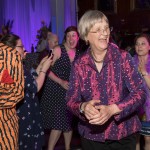
Outgoing President Drew Faust dances at Thursday’s celebration of her 11 years at Harvard’s helm. Photos by Jon Chase/Harvard Staff Photographer
Tributes, humor, and music honor Harvard’s 28th president, with dancing as dessertDrew Faust said goodbye as Harvard’s president Thursday as members of the University community celebrated her 11 years as leader with humorous and heartfelt tributes and moving musical performances in Sanders Theatre, and dancing that stretched into the evening at Annenberg Hall.
Faust became the University’s 28th president in 2007, the first woman to hold that job. Yet the Virginia native, historian, professor, and founding dean of the Radcliffe Institute for Advanced Study was quick to tell those gathered at her opening press conference that she was “not the woman president of Harvard; I’m the president of Harvard.”
Thursday’s party bookended the celebration of her inauguration on Oct. 11, 2007, which also was in Sanders Theatre, and which included musical tributes from students, alumni, and professors, as well as a humorous video introduced by actor John Lithgow ’67 titled “A Primer for a President.” On Thursday, several guests looked back to rate Faust on her years in Massachusetts Hall, offering grades in a number of “presidential” lessons. Unsurprisingly, she aced them all.
Lithgow, the afternoon’s master of ceremonies, kicked off the tribute with archival photos of Faust, and asked the faculty present to stand as he called for a voice vote to “celebrate and commend Drew Faust for a job well done.” The faculty gave a resounding “aye.”
“Achieving faculty consensus is an art,” quipped Lithgow, who gave Faust an A for “Lesson One: Take control of faculty meetings.”
Master of ceremonies John Lithgow gives Faust her dance card.
Actor Courtney B. Vance ’82 and his two children awarded Faust an A-plus for her ability to honor traditions while being unafraid to question and challenge ones “that may have outlived their usefulness,” including the term “House master,” which Faust worked to replace with “faculty dean.”
Harvard’s 31st treasurer, Paul Finnegan ’75, praised Faust, who took office on the eve of the 2008 financial crisis, for staying strong during adversity. “When the going got tough, you got tougher. You acted swiftly but with care,” Finnegan said, offering her an AAA credit rating in lieu of a grade.
Faust also got high marks for taking chances during her presidency from someone who knows about taking public risks for a living. “You just have to be willing to screw up and not freak out when you do screw up, because you will screw up. I mean, you are really going to screw up,” joked comedian Conan O’Brien ’85 in a video clip.
Faust was also praised for using her position to fight for what she thought was right, for her devotion to athletics, and for her commitment to the sciences, which earned for her from Lithgow a new element on the periodic table: Drewdium.
When it came to picking advisers, Jack Reardon ’60, a former admissions officer, athletic director, and head of the Harvard Alumni Association, said Faust deserved high marks for having the most important expert always in her corner, Charles Rosenberg, Ernest E. Monrad Professor of the Social Sciences Emeritus — her husband.
Top marks for “Don’t Forget the Arts” were never in doubt. Faust made incorporating the arts into campus life a hallmark of her presidency. She helped introduce the Theater, Dance & Media concentration and added art to Harvard Yard. Diane Paulus ’87, artistic director of the American Repertory Theater, said she was “continually inspired by President Faust’s profound understanding that the arts have the unique ability to engage our hearts as well as our minds.” She then introduced a segment by jazz great Wynton Marsalis, who helmed a two-year performance and lectures series at Harvard, ushered in through Faust.
Wynton Marsalis performs.
“The project that is higher education, that is opening minds and changing lives and discovering truths, it’s just an exhilarating privilege to be part of it and to have been in this institution and to have watched so many talented people — and you saw a lot of them onstage tonight — commit themselves to this project,” said Faust, offering her thanks to the crowd.
“You have done the work that I was being praised for tonight,” Faust said. “This has been a collective enterprise, and it’s a collective enterprise that I know is going to continue in support of my successor, Larry Bacow.”
Faust shares a moment with her successor, Larry Bacow.
Mandolinist Forrest O’Connor ’10 and guitarist Jim Shirey ’11, members of the Grammy-winning bluegrass ensemble the Mark O’Connor Band, took the stage as part of a group called the Drew Crew. Aditya Raguram ’18, pianist and research fellow in genetics at Harvard Medical School, also performed, as did singer Joshuah Campbell ’16, who concluded the ceremony with a lively rendition of The Temptations’ “Ain’t Too Proud to Beg.” That got Faust up on her feet to bust a move center stage with Lithgow.
Drew Faust and Larry Bacow on learning from each other, the value of humility in decision-making, and the biggest challenges facing higher education
Attendees were then treated to a dance party in Annenberg Hall, which was transformed into a disco with neon lights, a D.J., a black-and-white checked dance floor, and some of Faust’s favorite foods, including shrimp dumplings, beef sliders, falafel wraps, bacon, and chocolate.
Jeffrey Douyon, a staff assistant at the Harvard Alumni Association, said that while he had never met Faust he felt as if he knew her after attending the celebration. Hearing “so many kind and beautiful words about her work over the last 11 years and to just be a part of the spirit of this room tonight was beautiful,” said Douyon.
“It’s bittersweet,” he added. “It’s sad to see her go. On the other hand, I am excited to see how her legacy lasts here at Harvard.”
Study explores how brain processes temperature information, influences behavior
Do you pause what you’re doing to put on a sweater because you feel chilly? Do you click the thermostat up a few degrees on a winter day? What about keeping a fan on your desk, or ducking into an air-conditioned room to beat the heat?
If so (and, let’s face it, everyone has), then you’ve used sensory information about your environment — the temperature — to alter your behavior.
But exactly how the brain processes that information has largely remained a mystery. To shed light on that, a team of researchers led by Martin Haesemeyer, a research associate in the labs of Florian Engert, professor of molecular and cellular biology, and Alexander Schier, the Leo Erikson Life Sciences Professor of Molecular and Cellular Biology, turned to an unlikely subject: zebrafish.
Using whole-brain imaging techniques, Haesemeyer was able to show how sensory neurons innervating the face detect environmental temperature, and how this information is passed on to the hindbrain of the fish, where it is processed to produce behavior. The study is described in a paper published earlier this year in Neuron.
“Unlike us, zebrafish can’t regulate their body temperature,” Haesemeyer said. “They live in fairly shallow pools like rice paddies and small ponds [where] the temperature can fluctuate quite a lot, so being able to navigate those temperature gradients is important.”
The temperature-sensing process in zebrafish, Haesemeyer said, begins in much the same way as it does for humans, with somatosensory neurons in the face. The neurons that detect temperature changes are cells in a structure called the trigeminal ganglion.
“In the hindbrain we also find cells that use this signal to not only process how warm it is, but to calculate the direction of change, so the fish can tell if it’s getting warmer or cooler,” said Martin Haesemeyer (left). Rose Lincoln/Harvard Staff Photographer
“In humans — and zebrafish — this structure is located somewhere between the eyes and the ears,” Haesemeyer said. “We can then look at how the trigeminal ganglion encodes the temperature and what those cells do when the temperature changes. What we find is there are cells which are excited when temperatures increase, while others fire more when temperatures are low. What happens from there is these cells project to an area in the hindbrain of the fish.”
While that temperature information is encoded in the firing rates of the neurons, on its own that’s not enough to alter the behavior of the fish, Haesemeyer said.
“There’s a computation that happens to extract more information,” he said. “In the hindbrain we also find cells that use this signal to not only process how warm it is, but to calculate the direction of change, so the fish can tell if it’s getting warmer or cooler.”
While more work is needed to understand fully how the neurons make that calculation, Haesemeyer said researchers have a strong hypothesis.
“The way we think this works is to rely on the adaptation of neurons,” he said. “What that means is if you give neurons the same strength of input for a long time, what you see is they initially fire a lot, but the activity eventually falls off. We think that’s what is happening here. We think there are cells in the hindbrain that are connected to the trigeminal ganglion cells, and these hindbrain cells will be almost silent if the temperature is constant. But as soon as you get a change in temperature, those cells will start to fire.”
This research was supported with funding from an EMBO Long-Term Postdoctoral Fellowship, the Jane Coffin Childs Memorial Fund for Biomedical Research, and the National Institutes of Health.
Engert keeps moving, whether at work or play
Harvard scientists develop new techniques to track how cells develop
Haesemeyer said he plans to work on getting a more detailed picture of the neural circuit in the hind brain that translates heat information into behavior.
“What we have from this study is a model that is pretty good at taking stimuli and predicting activity in the brain and behavior,” he said. “But it’s not a full-circuit implementation, so one place I want to go is to better understand how connectivity and cellular properties shape this computation, because calculating the direction of change allows the fish, or any other animal, to do a simple form of prediction.
“I imagine this is a fairly widespread motif, so I think it will be interesting to study exactly how it is implemented in the hind brain, because I think it’s probably consistent across many animals,” he added.
This research was supported with funding from an EMBO Long-Term Postdoctoral Fellowship, the Jane Coffin Childs Memorial Fund for Biomedical Research, and the National Institutes of Health.
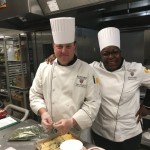
Nearly three-and-a-half years after they created Forward Food plant-based culinary training at Harvard, Chef Wanda White and Ken Botts of the Humane Society of the United States returned to campus on June 4 and 5 to lead Harvard University Dining Services’ (HUDS) chefs and managers through a two-day intensive training and tasting on plant-based cuisine.
In the intervening time, plants have moved to the center of many diners’ plates, as individuals recognize the health and environmental benefits of making fruits, vegetables, beans, grains, nuts and seeds the greatest focus of their daily meals.
At Harvard, while the number of students who identify as vegan or vegetarian hasn’t changed much, more forgo meat as a core component of every meal. In a recent satisfaction survey, 57 percent of student respondents noted it was very important to them to eat healthy, with another 38 percent saying it was somewhat important. At the center of their definition are lean proteins, whole grains and vegetables.
“This training gives our chefs a chance to reframe their thinking,” says David Davidson, managing director of HUDS. “Many of them were classically trained in a style where meat was the center of the plate and the core, defining flavor. Forward Food gives them an opportunity to explore new recipes, techniques and ingredients.”
“In January of 2015, HUDS asked us if we did kitchen-based training programs,” said Ken Botts, director of Food and nutrition for the Humane Society of the United States. “I said yes, but the truth was we hadn’t ever done a formal program. We created it here, and since that first program we’ve done more than 160 culinary workshops, training more than 2,400 professionals, across the United States, and just recently extending to Canada, Europe, and South America.”
“We’ve been doing a great deal of work making plants a more prominent feature on our menu,” notes Martin Breslin, HUDS’ director for Culinary Operations. “This past year, we added a dedicated plant protein dish at every lunch and dinner. By the end of the school year, we’d served almost 47,000 pounds more plant proteins than the year before. We’ve altered the ratio of meat to vegetables in countless dishes, and created stations where students can really tailor a dish’s contents to make meat a condiment, rather than a feature.”
Botts notes, “It’s invaluable to us to work with food service teams like Harvard’s. They are on the front line, responding to student tastes, but also shaping the way they’ll view and consume food moving forward. What happens in a campus dining hall can alter an individual’s approach to food for the rest of their lives, and we’re thrilled to contribute to the knowledge base that will help guide that toward a more sustainable future.”
“It’s awesome to watch our team embrace new ways of thinking,” says Davidson. “They’re tasting these new recipes and they’re excited by the possibilities. They’re energized by the work.”
Drew Faust and Larry Bacow on learning from each other, the value of humility in decision-making, and the biggest challenges facing higher education
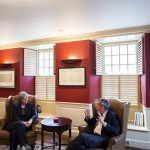
Since their first meeting 10 years ago, Drew Faust and Larry Bacow have become invaluable sources of support and advice to each other, as well as good friends. The 28th Harvard president and the 29th sat down at Massachusetts Hall for a conversation that ranged from their childhoods in Virginia and Michigan, respectively, to the art of listening, to the role of colleges and universities in supporting the American dream.
Bacow, former chancellor at the Massachusetts Institute of Technology and president of Tufts University from 2001 to 2011, is a lawyer and economist by training whose research focuses on environmental policy. He will succeed Faust on July 1.
GAZETTE: Can you tell me how you met?
FAUST: When I was named president in 2007, Larry was president of Tufts, and he called up and invited Charles and me to dinner the first night of my presidency. So on July 1, 2007, Charles and I went to the president’s house. [Charles Rosenberg is President Faust’s husband.]
Larry and Adele cooked dinner for us. [Bacow is married to Adele Fleet Bacow.] So that was a lovely beginning. And there is a kind of addendum to this. About a year, a year and a half ago, when I confided to Larry that I was going to be stepping down, we made a date to have dinner on the first night of my non-presidency, which turns out to be the first night of his presidency, which I think neither one of us had anticipated at the moment we set the date.
BACOW: Absolutely.
FAUST:So on July 1, 2018, we will be having dinner, and by all fairness I ought to cook, but I don’t think I am going to have a kitchen, a place to live.
GAZETTE:Where will it be?
BACOW:It’s going to be at our place.
FAUST:The first day after you step down, I will cook for you. There’s a new date.
BACOW:There you go.
FAUST: Just to build on this, after we met, Larry was hugely helpful to me as a new president, especially after the financial crisis, when we were both facing things that neither one of us had ever faced before. We did a kind of home-and-home arrangement, where I’d go to Tufts to the president’s house, or he would come to Elmwood.
BACOW:We’d open up a nice bottle of something, we’d put a significant dent in it, and we’d commiserate.
FAUST:And the financial crisis looked so much better after those conversations.
BACOW:When I announced that I was leaving Tufts, I was invited to join the Harvard Corporation, and then we just kept seeing each other. A number of people have asked me about the transition and I keep telling them that this transition is actually much easier than the transition to Tufts because I know the place better. It knows me as well. I think for the last seven years, once a month you and I have had breakfast or lunch and once a month [Provost] Alan [Garber] and I have had breakfast or lunch, which means, since those are often staggered, about every other week I’ve had breakfast or lunch with one of you. To say nothing of all the other meals I have eaten in service to Harvard. So we’ve really gotten to know each other quite well.
GAZETTE:What are the most important things you have learned from each other during your respective 10 years leading Harvard and Tufts?
FAUST:I remember one of our meetings in the living room at the president’s house at Tufts in the middle of the financial crisis, you shared with me a statement that you had delivered to the Tufts community. I remember thinking, “This is so admirably straightforward. So open about what’s going on, so direct.” I think Larry’s directness during that time was an inspiration to me and reinforcing of instincts that I might have had but may not have dared to act on quite so directly. So that was a big influence.
BACOW:Thank you. I’ve learned a lot from Drew over the last seven years about Harvard. Drew has managed with incredible grace to bring Harvard together. We talk about “One Harvard,” but it’s the way in which she has engaged people that I will try to emulate. She’s been a wonderful listener, which is important for any president. But she’s also been a forceful advocate internally for a set of principles and values. You have been very consistent in your messages, and I think that that’s how you get things done, especially in a place that’s as large and decentralized as this one. So there are many things that I will try to emulate, but I can only hope to come close to Drew’s style and grace.
GAZETTE:Will you continue to connect with each other for advice and suggestions?
BACOW:Oh, yeah. I kid Drew that I’ve added up all the phone calls and the meals together when she has been asking me for advice. So I have this big account surplus which I intend to spend down now. Drew will be on speed dial, trust me. And of course, I will be channeling her at times as well.
FAUST: At his request, I will do whatever he asks. I was touched because Katie Tiger, who does my schedule, said, “Larry’s called up and he wants to schedule time with you,” and I thought, Well, I’m not going to be president anymore. She said, “He wants to connect the way you did, once a month.”
BACOW:Exactly, once a month. If Charles will allow. Both of our spouses have sort of suffered through these periods where they have had to share us with the rest of the world: Right? And now Charles gets you back, and not just Charles, but your daughter and your friends.
GAZETTE:Can you both speak a little bit more about how you balance these public-facing roles with your private lives?
BACOW:I think Adele and I have had an advantage, at least relative to many college and university presidents, because we’ve lived in Boston since we came here as freshmen in 1969. And so we have all of these wonderful friends who have known us forever as Adele and Larry. I think when people move to a new city and they show up in these roles, it’s really, really hard to make the kind of friendships that permit you to be unguarded, open, where you share some of your personal frustrations at times with people where it’s safe to do so. And so we are blessed with these friends, and they will still be our friends now that we moved into these new roles. So that’s helped us to preserve a sense of private time.
Our children are very important to us. They live in New York City. We have two sons, both married with families of their own. Drew tells me that she’s actually spent a little bit of time in New York during her tenure as president of Harvard, so I am assuming I will have plenty of opportunities to get there as well. But finding time for family and friends is hard. You make a lot of sacrifices in these jobs.
FAUST: How old was your youngest son when you started as chancellor at MIT?
BACOW:It was Jay’s freshman year in college, so Kenny was a junior in high school.
FAUST: So they were pretty far along before you really took on big administrative responsibilities.
BACOW:They were. But Adele and Kenny actually did an intervention at one point with me. As chancellor I was going into the office every weekend and they finally had to sit me down to say, “Something has to change.” I went in to talk to [then-MIT President] Chuck Vest the next day, and said, “I am willing to sacrifice a lot for MIT and for this job, but not my family.” And he said: “Absolutely right.” So I restructured things.
It’s interesting, when I moved into the presidency in some ways I found it easier to manage my schedule than when I was chancellor at MIT.
FAUST: Because you were in charge?
BACOW:Because I was in charge. You control your own schedule to a much greater degree as president.
FAUST: The advice I would give to any new dean or anybody taking on a big position is: “You are the only person who has your interests at heart in terms of time management. Everyone else is going to try to get you to do stuff, so take control of it.”
GAZETTE:I wanted to ask both of you about people you have sought out for advice.
FAUST: Oh, my gosh, there are lists and lists and lists.
GAZETTE: Anyone who comes to the top?
FAUST: Members of our governing board. Different people at different times. Bill Lee has been a wonderful mentor to me from the moment we first met each other at a dinner during the presidential search. A person of such good judgment, and calm in the face of whatever is going on, with a deep understanding of Harvard. He has been terrific. But I am a big advice-seeker. I talk to anybody I can find that I think might have a perspective. I talk to alums when I am on a development visit, and if someone has great accomplishments in running an organization or thinking about financial questions, I just seek their advice on whatever issues are troubling me at the moment.
BACOW: In addition to Drew, when I was at Tufts there were a couple of other presidents I always turned to. One was Chuck Vest, another was Bill Bowen, former president of Princeton and the Mellon Foundation, another one was Jim Freedman, the former president of Dartmouth. With certain things I think it’s helpful to talk to people who have sat in the same chair, if not at the same institution.
And then we have these wonderful friends who we go way back with. We had a dinner party the first or second year that we were married — this is over 40 years ago. We invited three couples that did not know each other at the time. And the eight of us, joined by one other couple — newbies because they joined 17 years ago — have been getting together for dinner ever since. We’ve grown up together. A couple of us are academics, one is a federal judge, one ran another huge organization. So there’s a lot of life experience there. I can’t think of an issue where I couldn’t learn from people in that group.
GAZETTE:Could you both weigh in on what you see as the greatest challenge facing higher education today in the U.S.?
FAUST:I would say skepticism about the value of higher education, and skepticism about higher education’s product: facts, science, knowledge, an educated citizenry that is not just narrowly trained but broadly educated. We have to make a case for all of those things, and a lot of our other challenges derive from the reality that I just described.
BACOW:I would agree. I think as the real cost of higher education has increased people have adopted more of a consumerist or instrumental approach to higher education. What does it do for me? What’s the return on it in the very narrow, short term? There’s a proposal to evaluate colleges and universities based on the incomes of their graduates after their first job. By that metric, Drew, both you and I would have been considered failures coming out of our alma maters.
FAUST: Yep.
BACOW: Because we each took a first job that paid a pittance relative to some other jobs. So I think that the current narrative about higher education in the U.S. is one that we have to work really hard to change. As Drew says, people are questioning the value of a diploma. They are questioning the value of these institutions to society. They are questioning whether or not colleges and universities actually contribute to the American dream. That’s scary. We need to change that conversation.
GAZETTE:As the incoming president of Harvard, what do you see as your greatest challenge in your first year?
BACOW:One of the things which I learned during my time at Tufts is that a university presidency is a marathon, it’s not a sprint. And having run the Boston Marathon multiple times, I can tell you that one of the big mistakes that new marathon runners make is that they try to go out too fast. And so I anticipate spending a fair amount of this first year listening, learning. I know a lot about this institution from my time on the Corporation, but that’s nothing close to what I need to know in order to do this job effectively. I would say my biggest challenge is going to be getting to know Harvard really, really well, so that I can be an informed leader and make the kinds of judgments which Drew probably makes like that [snaps fingers].
GAZETTE:Is there something outside of your personal lives, something that has had a big influence on the way you have run things? Anything outside of your professional lives that you have been able to bring into your careers?
FAUST:Well, I get asked about this, and the more I am asked about it and the more I answer, the more I am convinced it is true, which is how history has influenced me — how it’s influenced my approach to thinking about this job. I’ve said often that leadership is about change. It’s about people resisting change or embracing change, it’s about bringing an organization through change. But I’ve been thinking recently about how the way I’ve always done history is to listen; to listen to voices from the past to try to figure out how they are seeing the world. And for me that’s how I ended up writing about death. Prior to “This Republic of Suffering,” I wrote a book about Confederate women, and what they were writing about all the time was death. So it was really reading their letters and listening to their voices that made me understand what I needed to say and do and what was important.
I think that kind of training in historical listening has been an important part of it, the essence of listening as a leader, which, I think both of us agree, is seminal to how to get the work done.
BACOW: It’s interesting how our scholarly backgrounds influence how we see the world and how we do our jobs. I spent a fair amount of time in my career doing research and thinking about bargaining and negotiation and dispute resolution. If you want to try to move a group you need to understand the different interests and perspectives and be able to respond to them. And you need to be able to frame issues in ways so that people can imagine a future that’s different from the past, and can see how there’s a place for them in that future.
So, in the same way, Drew, that you probably look at life through the lens of history, I tend to look at life through a lens in which I am trying to understand how one can bring people to consensus, or at least how to create an unblocked coalition. In other words, you can’t always get everybody to agree on a path, but at least if you get enough people to agree it allows you to move forward. In that respect I think my scholarly background also plays a role in how I lead.
FAUST:Which came first? Did you become an economist because this was your perspective on the world, or is this the perspective you have because you are an economist? I wonder about that a lot. Was I attracted to history because I tended to see things this way? Or are both true?
BACOW:This is what in economics we would call an identification problem [laughs]. I’d have to spend a fair amount of time on somebody’s couch in order to figure that one out. But, you know, it’s also the case that while our disciplinary lenses can help us see and understand the world in ways that we might not otherwise see them, they can also be constricting. And it’s important to understand when to take the glasses off and see the world in different ways. There are times when I have to stop being an economist, and I assume you have to stop being a historian.
FAUST:That reminds me of a story about Larry Summers sitting in that chair and me sitting here for five years of his presidency while I was the Radcliffe dean. He talked about the world in a way that was so different from my take on the world, in that things were about numbers and things were about reducing complexity. Humanists always want to enhance complexity. I ended up writing a chapter in “This Republic of Suffering” that I don’t think I would have written had I not had those interactions. It’s a chapter about numbers, about counting the dead and what numbers came to mean and how thinking about numbers was a way to try to grapple with the ineffability of the tragedy. It was really sort of seeing, almost as an anthropologist, how Larry’s mind worked that made me able to see different things in my research.
GAZETTE:Can it be daunting, trying to grapple with a wealth of information and knowledge from different sources? Do you ever feel overwhelmed?
FAUST:It’s humbling.
BACOW:Yes, it is humbling. And you need to approach conversations with humility. I think that’s really important.
FAUST:A kind of respect for the craft and culture of the field that you are exploring.
BACOW:But at the same time we are also constantly being asked to make judgments about scholarship, about who is worthy of promotion, about who ought to be a dean, about taste, good judgment. And we are being asked to assess people in fields radically distant from our own as well. This is why approaching these decisions with humility is important.
GAZETTE:President Faust, you have spoken about how growing up in Virginia’s Shenandoah Valley had a strong impact on your choices and your love of history. Incoming President Bacow, I wonder if you could talk about your own background and if being the son of Jewish immigrants from Holocaust-era Europe may have affected the choices you made in your life?
BACOW: I think I’ve always felt a certain sense of responsibility to others. I said this when I was introduced to the Harvard community. I think my life in so many respects mirrors that of so many other people whose families came to this country in search of opportunity. This country has just been enormously good to me, and so a lot of what motivates me, a lot of the reasons I agreed to take this job, especially at this point in time for all the reasons we discussed earlier, is to ensure that others have access to the American dream just as I have. So in that respect, I do think it affects my view of the world. It affects how I see my role in the world, and for those of us who have been blessed to be able to study in places like this, to be able to work in places like this, I do think we bear a special responsibility to use the gifts that we’ve been given to try to make the world a better place.
GAZETTE: Did either of you have a sense of what you wanted to be when you were young? President Faust, I think you wanted to be a veterinarian?
FAUST: Yes, animals are very important to me and always have been. I grew up on a farm and I raised every animal you can imagine as a child. Horses, cattle, sheep, goats, chickens, dogs, cats.
BACOW: As a kid growing up I was really interested in science and math. I entered science fairs. I built Heathkits.
GAZETTE:Where did that interest come from?
BACOW: I loved numbers. I loved science. I read voraciously about science from the time I was really young. I actually ended up going to MIT because I kept reading about it in Popular Science and Scientific American. But I never actually thought I would be a scientist. I always thought I wanted to be a lawyer. It was only after I went to law school that I figured out I didn’t. I am not sorry I went to law school, but I realized I wasn’t cut out to practice law. I was enrolled in a joint degree program between Harvard Law School and Harvard Kennedy School and decided to complete the work for a Ph.D. from the Kennedy School, not intending to be an academic. I thought I was going to go work, with the start of the Carter administration, in Washington, D.C. Then I had an opportunity to fill in for somebody who was on leave from MIT for two years. A two-year, nontenured track. When I was contemplating whether or not to do it I went back to see my mentor at MIT, Bob Solow. He said, “You know, the government will be there when you are ready to go work for it.” So I took the job at MIT and two years turned into 24. And I am still at it on some level.
GAZETTE:I noticed an interesting parallel in your childhoods. President Faust, you were in the 4-H Club and the Brownies, while incoming President Bacow was a Boy Scout who eventually made it to Eagle Scout. Were these formative experiences?
FAUST:4-H was very important to me. I loved the responsibility of taking care of this steer and learning all about animal husbandry, and the county agent would stop by to see how I was doing. So it was a lot of fun.
BACOW:I learned a lot in Boy Scouts. One of the things which I learned is that I enjoy teaching. I went to Boy Scout camp one summer — you would only go for a week — and at the end of the week they realized that the person who was supposed to teach the next cooking merit badge session wasn’t going to show up, so they needed somebody to do that.
FAUST:So you have a cooking merit badge?
BACOW: Oh, I do. Not only that but I taught cooking merit badge.
FAUST: Wow, I should have recognized that when I had that delicious dinner back in 2007.
BACOW:In fact, the final project for each of my students was that they had to bake a pie in a Dutch oven over an open flame. It was the first time I ever had an opportunity to teach, and I realized I enjoyed teaching. That’s where the seed was planted. But I also learned a lot of other useful life skills.
GAZETTE:I wonder how being a professor has helped inform leadership for each of you?
FAUST:It was absolutely defining in that it gives you a perspective on the university from one of the most, if not the most, important elements of the university — the faculty. They are the ones who live through an era at a university, and have so much responsibility and power in university governance, and embody the intellectual mission of the place. So understanding that culture and those values was very important. On a more instrumental level I think that teaching large classes, lecturing, answering questions, having to explain things to people, was an invaluable preparation for the kind of work a president does. It’s about learning how to communicate and explaining things to people that they might not understand initially or that they might not know about, and responding to their queries about issues. Those are all things that are very much a part of my life every day.
BACOW:I avoided academic administration for 21 of my 24 years as a faculty member.
FAUST:You know both of us did that. We are both really late starters.
BACOW:I loved the life of a faculty member. Why screw it up? It was a wonderful life. When I moved into administration, when I became chancellor at MIT, I found that there was an interesting opportunity to fix things that bothered me as a faculty member and it was very gratifying to be able to do that. Now what I say all the time, because I believe it, and I know Drew does as well, is the job of an administration, our job, is to enable faculty to do their best work, their best teaching, their best scholarship. And I think if you haven’t done it yourself, you don’t know what that is. And so I think we do what we do because we believe in the work of the faculty. If we didn’t, then I think we would be miscast in these roles.
FAUST:Well put.
GAZETTE:What’s the hardest part about being a university president?
BACOW: The hardest part is keeping your waistline under control [laughter]. I used to joke when I was at Tufts that my real title was not president, it was university stomach. But I ate in service to the institution.
FAUST:Yes, eating for Harvard.
BACOW:Don’t you find it that way?
FAUST: Oh, yes.
BACOW:So that was one of the hardest things.
FAUST:I think the hardest part is just having to be steady and always know that how you react to a situation is going to affect so many people around you. In a moment of difficulty or crisis or whatever it might be, you need to be a symbol of the institution. The responsibility is wonderful in many ways because it comes with the ability to do things and to fix things and to change things and accomplish things. But it is also in itself a huge responsibility.
BACOW:One piece of advice I give to every new university president I speak to is to always do the right thing. It’s usually not that difficult to figure out; it’s often excruciatingly difficult to do. And being able to constantly focus on what’s the right thing for the institution long-term. Watching how others have maintained their balance through difficult times can be very instructive and very reassuring. These jobs are not for the faint of heart.
GAZETTE:President Faust, is there one piece of advice you would offer your friend as he steps into this role?
FAUST:Make sure you do things that just give you joy. There is so much around this campus. In the myriad of choices and obligations that people will present to you, make sure you put lots of them in there that you enjoy. Because there is much joy to be had, and I worry sometimes that we don’t take enough joy in what the work of this place is. It’s very serious work and it’s work that has enormous relevance and impact, and changes lives, as you were describing. But it’s also so miraculous to be here with people learning and discovering and to be sharing that with them. So celebrate that.
BACOW:I will.
GAZETTE:Thank you both so much for taking the time.
FAUST: Of course.
BACOW: This was fun.
GAZETTE: My last question, for incoming President Bacow: Red Sox or Detroit Tigers?
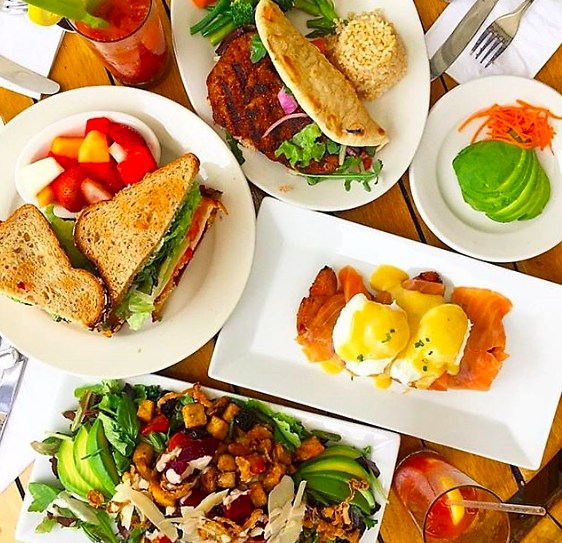
Summertime and the living’s easy. For all of those late nights out partying in the Hamptons, there needs be a morning fix worth getting out of bed for. From local favorites to city exports, there’s no better way to start your weekend than at these top brunch spots out East. After all, brunch is the most important meal of the week.
Babette’s
There’s a reason there’s always a line congregating on the sidewalk in front of Babette’s in the afternoon. And it’s not just because there’s a fairly good chance you’ll find yourself sitting next to Martha Stewart. They’ve the best eggs (and the most egg dishes) out East!
Start the day on a slightly more unique note than just the usual go-to with a light, crispy dosa. A sourdough crépe made from rice and lentils, filled with eggs, spinach, roasted tomatoes, jack cheese.
A concept so simply perfect it couldn’t help but replicate itself in 4 towns out East (Bridge, South, Sag and East), only a place like The Golden Pear Cafe could get away with having a Hedge Fund Omelet on the menu. A bakery spread of sugary options too good to pass up. Breakfast served on a plastic tray for those choosing to eat in. What could be better?
A beloved hidden gem on the outskirts of Sag Harbor, Estia’s Little Kitchen leaves little to be desired when it comes to their brunch menu. From a nacho-style omelet, to apple buttermilk pancakes, and a breakfast burrito section that will have you completely indecisive, this shingled shack is as cozy as it gets.
On the one hand, everyone’s favorite vineyard turned bohemian eatery that’s taken over Sag and Amagansett has an Açaí bowl and Green Goddess Kale salad that will have you perfectly beach ready. But, on the other hand, you only live once, so why not wake up to a lobster roll and fries, or a brioche grilled cheese with pulled pork, or crab avocado toast?
New York’s beloved uptown party brunch keeps afternoon fun alive out East. The Sag Harbor satellite location is perched right on the water, with a prime, up close view of the marina, the deck makes for a more than pleasant place to pop open a magnum of rosé, and settle in for a slow, boozy brunch.
Le Bilboquet, 1 Long Wharf, Sag Harbor
Lulu Kitchen & Bar
The Gravlax Pizza, straight out of their wood fired oven, is a MUST order at Lulu Kitchen & Bar. House smoked salmon, ricotta, mozzarella, crème fraiche, lemon zest, pickled red onion, fried capers, frisée, dill lemon oil! The stuff dreams are made of.
‘Tis the season for over-hyped music festivals boasting massive headliners and crowds of teenagers. Listen, we don’t judge – perhaps you’re into that. But when it comes to cool, there’s only one annual rage fest that New York insiders and influencers are proud to post on Instagram – and it’s going down this Saturday.
Returning for its 8th year, Full Moon is one of the city’s largest independent festivals, celebrating music, art, leisure, and NYC’s “restless spirit.” No wonder it’s so beloved by the artsy types. Produced by MATTE Projects, a creative agency known for throwing some of the best bashes around the five boroughs, it’s inspired by the epic Full Moon Party that goes down in Thailand every year. Truth be told, however, our’s is way chicer.
Taking over The Knockdown Center in Queens for 2018, Full Moon Fest will spotlight a diverse lineup of performers, including Metronomy, LCD Soundsystem’s James Murphy, GE-OLOGY, and Jackmaster across three stages. Proving just what kind of party this is, the fun goes until 4 am – so get those energy drinks ready. Don’t worry, though, the all-day event will have plenty of fuel on-site, with foodie vendors from Matchabar to Rad Times Pizza serving up grub.
If you have a favorite SoulCycle instructor in the Hamptons, it’s time to make a change. Yes, we get that you’ve been heading to the East End since you were four, but maybe give some newbies a chance? You know, while switching up the scene for yourself. Think of a new summer town as Vintner’s Daughter for the soul. Instead of repeating your seasonal routine, list your Hamptons house on Airbnb and use your gains to travel somewhere that you haven’t Instagrammed into oblivion.
Use this calculator to estimate how much you could earn this summer by not being so predictable it hurts. Keeping Hamptons standards of beach, shopping, and food in mind, we’ve curated the best places to manifest destiny. Maybe you’ll discover your new annual favorite!
Nantucket
Nantucket means hydrangeas, overs and vehicle permit stickers, and grey cedar shingles. Go for the Nantucket Comedy Festival. Go for Boston Pops. Or embrace tradition and go to the Chicken Box and see everyone you know from prep school. Shop on the Straight Wharf and see…everyone you know from prep school. Go to Cru and see…Lord Disick? If you’re lucky, your exploits will be chronicled by @chadtucket.
Kiawah Island
If you usually head out East with the family, Kiawah is a great substitute. With southern food (corn bread at every meal), you’ll want to be with people who love you unconditionally. When you’re not golfing or playing tennis, take a skeet shooting lesson and discover which of your siblings has a secret proclivity for violence. Go on a guided kayaking tour and regret it when they tell you to beware of alligators.
Manhattan Beach
Home to the first LF I ever shopped at circa 2007, Manhattan Beach is great if you happen to be traveling with someone who requires outdoor activities. While you shop and apply SPF, they can bike on The Strand and play volleyball. Go to the pier and take that photo you promised yourself you wouldn’t.
Sea Island
With southern architecture and southern charm, Sea Island is the best escape you’ve never heard of. It has vibes similar to Kiawah, but you’re even less likely to run into anyone you know. Golf and tennis abound so make sure to pack your FaceGym serums. See if listing your summer home can fund a restorative week in Sea Island.
Palm Beach
Palm Beach is for those of you who consider small town charm an affectation. Unabashedly ostentatious, Palm Beach proudly boasts a monument of the gilded age. When not ogling or taking part in conspicuous consumption, visit the artificial Peanut Island or snorkel in the artificial Lake Worth inlet. Palm Beach is @Miquela in place form: fake, but so beautiful you don’t care.
Cape May
If the pedestrian holds some kitsch appeal to you or if you’re up for nostalgia by way of Americana, head to Cape May. Where there were once very few options for fine dining, Cape May is now fluent in farm to table and açai bowls. Pick and choose which elements of a typical Jersey beach town you want to engage with, but admit boardwalk fries, games, and quaint/creepy Victorian inns have an everlasting charm. Don’t forget to buy salt water taffy as a souvenir for all your friends who refuse to leave the East End.


 Kaley Cuoco and her husband Karl Cook Norman Cook/Instagram


 Disneyland, Tokyo. Wikimedia Commons




 Wynton Marsalis performs.